
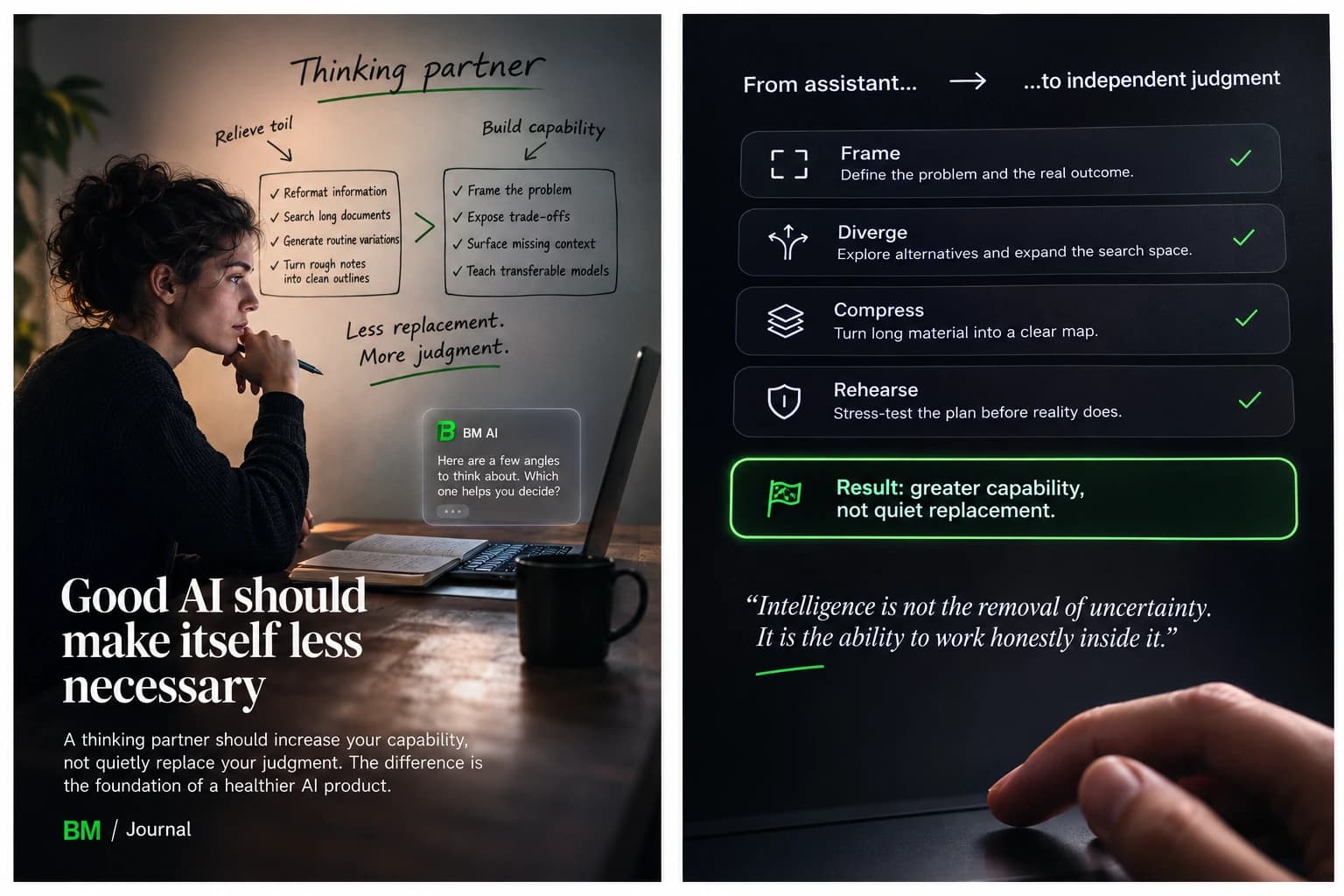
Calling an AI a “thinking partner” sets a higher bar than calling it a generator. A generator can return text that matches a request. A partner must help improve the request, notice what is missing, and leave the person in a better position to judge the result.
The phrase should not pretend the system is human. It describes a role in the work: something that can help frame, challenge, expand, compress, and rehearse an idea while the user remains responsible for the direction.
That role creates obligations.
Understand the real task
Prompts often describe an output before they describe a purpose. “Write an email” may mean repair trust, document a decision, decline politely, or create urgency. “Compare these tools” may mean minimize cost, protect privacy, reduce training time, or avoid a migration next year.
A useful partner works with the underlying decision. Sometimes it should ask a question. Sometimes context makes a reasonable assumption possible, but the assumption should be visible. Producing a perfect answer to the wrong task is not efficiency.
BM AI should help turn a request into a workable frame without making conversation feel like a form to complete.
Distinguish knowledge from inference
Fluent language blends facts, general patterns, and guesses into the same confident surface. People need those categories separated, especially when the answer influences a consequential decision.
A thinking partner should show where a claim came from when sources are available, label inference as inference, and say when current information needs checking. It should not use a vague disclaimer as permission to improvise everything that follows.
Uncertainty can be specific: this date may have changed; this conclusion depends on the assumption above; these two sources disagree; this recommendation reflects a value judgment. Specific uncertainty helps action. Generic uncertainty merely protects the system.
Challenge without taking over
Agreement feels helpful, which makes it a dangerous default. If an assistant always strengthens the user's first idea, it can turn a rough preference into a polished blind spot.
Challenge should be proportionate. A useful partner can surface the strongest counterargument, identify a stakeholder missing from the frame, or show the condition under which the recommendation would reverse. It does not need to manufacture debate around settled facts or bury a simple task under endless alternatives.
The goal is not friction for its own sake. It is to catch expensive certainty early.
Preserve the user's voice
Generated prose tends toward a smooth, average competence. That can rescue a rough draft and erase the qualities that made the draft worth reading. Voice lives in choices: what is noticed, what is omitted, where a sentence turns, and how much confidence a claim deserves.
Assistance should make those choices easier to control. Offer structures, explain edits, preserve distinctive language, and let the person decide when clarity is worth a change in tone. A thinking partner helps someone sound more like themselves at their best, not more like the assistant.
Make the handoff complete
There is a moment when help should end. The user needs the file, decision, explanation, plan, or next action in a form they can own. An assistant that keeps every result trapped inside a conversation has not completed the handoff.
Useful outputs are portable and inspectable. The reasoning should be concise enough to audit. The user should know what was changed, what remains uncertain, and what they may need to verify independently.
Increase capability
The best interaction sometimes ends with a result. The very best sometimes changes how the person approaches the next problem.
That is the direction for BM AI: remove avoidable toil while keeping judgment active. Help people move faster, but also help them see the structure of the work. The product earns the word “partner” when it increases agency rather than simply increasing output.


Loading the conversation…