
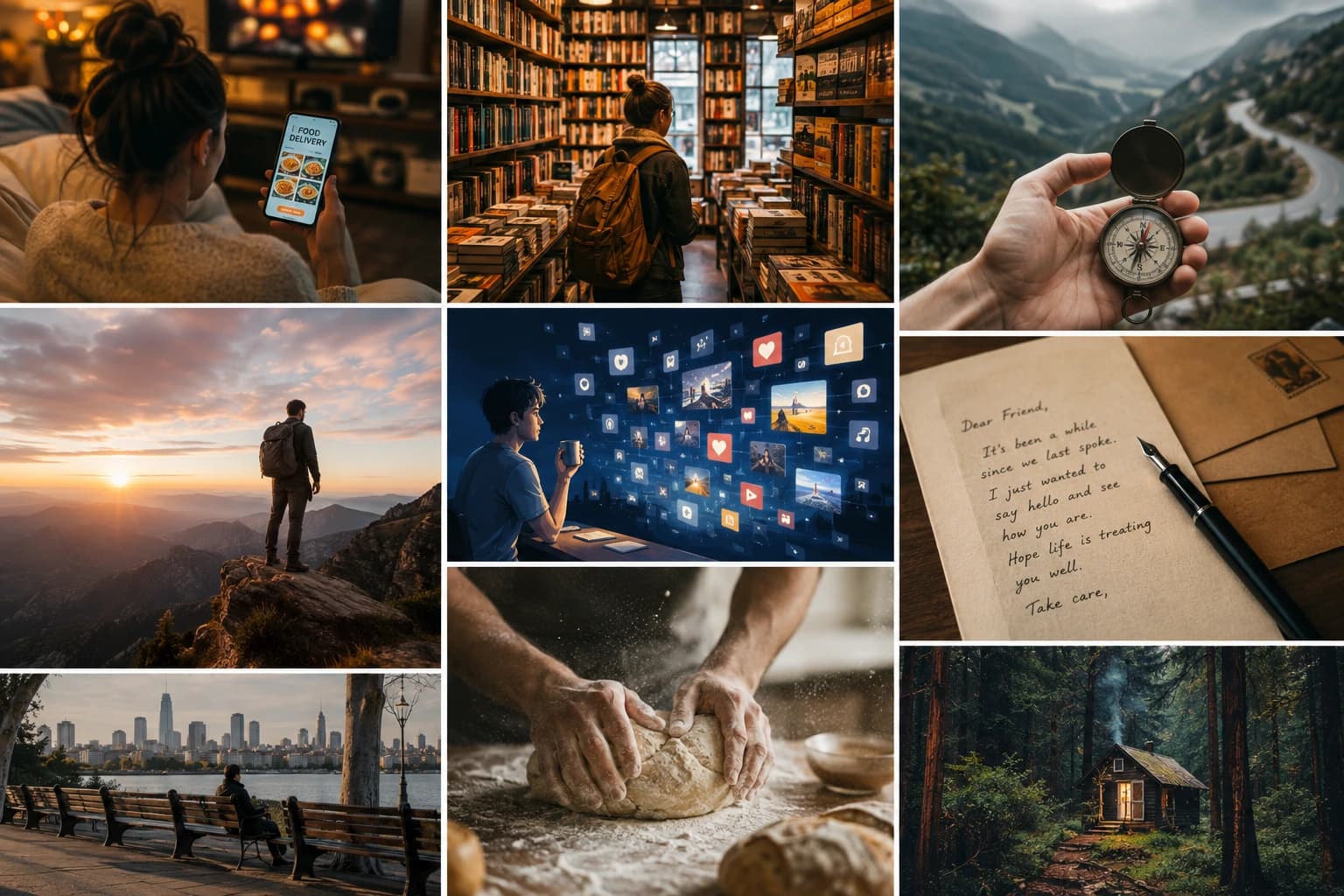
Modern life is built around a seductive promise: fewer steps.
Tap once and dinner appears. Subscribe once and toothpaste arrives before you remember you need it. Ask an algorithm what to watch, where to eat, how to get there, whom to date, what to buy, and increasingly, what to think about next.
We have spent decades removing friction from everyday life. And by almost every conventional measure, this is progress.
Yet something strange happens when convenience becomes the default rather than the exception. We save time, but do not necessarily feel that we have more of it. We reduce effort, but often feel more exhausted. We gain access to nearly everything, while becoming less certain about what we actually want.
The hidden cost of convenience is not laziness.
It is the gradual outsourcing of attention, judgment, memory, and agency.
And those may be among the most valuable things we possess.
Convenience Is Not Free. It Just Hides the Bill.
Economists traditionally describe a transaction in visible terms: money exchanged for a product or service. Digital life complicates this because many of its most important transactions involve currencies that do not appear on a receipt.
You do not simply pay $15 for food delivery.
You may also surrender the knowledge of which restaurants exist between your apartment and the restaurant you ordered from. You lose the small conversation with the person behind the counter. You avoid the weather, the walk, the unplanned detour, the moment of noticing that a new bookstore opened two blocks away.
None of these losses matter very much individually.
That is precisely why they accumulate so easily.
The great business innovation of the convenience economy has been to identify thousands of tiny inconveniences and turn their removal into products. The customer experiences each transaction as a small improvement.
But a life is not experienced transaction by transaction. It is experienced in aggregate.
A hundred saved walks eventually become a more sedentary body.
A thousand algorithmic recommendations eventually become a narrower cultural diet.
Years of GPS navigation eventually weaken your internal map of the city.
Automatic photo archives mean you never have to remember exactly when something happened.
Search engines mean you rarely have to sit with the discomfort of not knowing.
Artificial intelligence can now remove yet another layer of friction: the difficulty of forming the first draft of a thought.
Again, none of these tools is inherently harmful.
The question is what happens when every difficult thing starts to look like a design flaw.
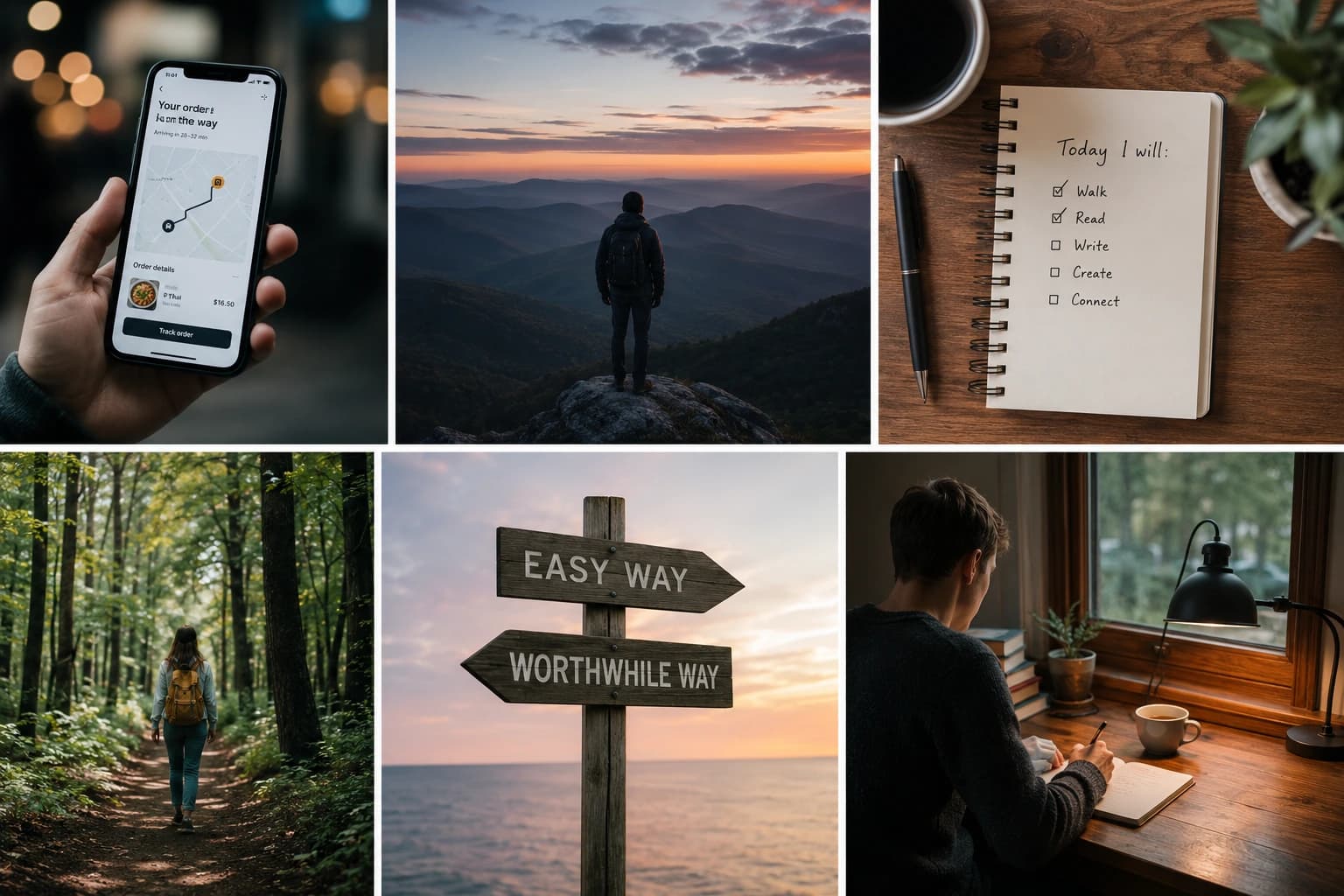
Friction Once Had a Job
We tend to talk about friction as though it were obviously undesirable.
Slow checkout pages are bad. Long forms are bad. Waiting is bad. Searching is bad. Getting lost is bad.
Product designers are trained to eliminate these moments because friction reduces conversion. The fewer obstacles between desire and fulfillment, the more likely a customer is to complete an action.
That logic works extraordinarily well in commerce.
It is less obvious that it works for human beings.
Some forms of friction are doing important work.
Consider the difference between browsing a physical bookstore and purchasing a book online.
The online experience is superior according to almost every measurable efficiency metric. You can search millions of titles instantly. Reviews are available. Prices are transparent. Recommendations are personalized. Purchasing takes seconds.
A bookstore is inefficient.
Its inventory is limited. The books are arranged according to somebody else's logic. You may have to walk upstairs. The book you want may not be available.
But those limitations create something difficult to measure: discovery.
You walk toward philosophy and pass architecture.
You pick up a novel because of its cover.
You overhear two strangers discussing a writer you have never read.
You leave with a book you did not know existed.
The inefficiency is part of the product.
Friction creates encounters.
The same principle applies elsewhere.
Cooking is less efficient than delivery, but cooking teaches taste, timing, patience, improvisation and care.
Walking is less efficient than driving, but walking reveals the texture of a neighborhood.
Conversation is less efficient than sending information, but conversation creates relationships.
Writing something yourself is less efficient than having software generate it, but the struggle to articulate an idea often changes the idea itself.
Sometimes the obstacle is not standing between you and the experience.
Sometimes the obstacle is the experience.
The Dangerous Transition From Tools to Defaults
Technology becomes most powerful when it disappears.
A tool you consciously choose remains a tool. A tool you stop noticing becomes infrastructure.
Few people wake up and make an explicit philosophical decision to outsource their sense of direction. They simply begin using GPS.
At first, navigation software is miraculous. You no longer need to study maps, memorize roads or ask strangers for directions.
Then something subtle changes.
Instead of using GPS when you are lost, you use it whenever you are going somewhere.
Then you use it to travel routes you already know.
Eventually the city begins to exist not as a mental landscape but as a sequence of instructions:
Turn left in 200 meters.
Continue straight.
Recalculating.
The technology has not merely helped you navigate the city. It has changed your relationship with the city.
This is the pattern worth watching.
Recommendation engines initially help us discover music. Eventually they become the primary way music reaches us.
Search engines initially help us find information. Eventually they influence which questions seem worth asking.
Social platforms initially help us follow people we know. Eventually algorithms decide which of those people we actually see.
AI initially helps us write. It may eventually influence how much unaided thinking occurs before writing begins.
The distinction between assistance and substitution rarely arrives with a dramatic announcement.
It happens through habit.
Convenience Changes Desire Itself
The deepest effect of convenience may be that it does not merely satisfy preferences.
It shapes them.
Imagine that every restaurant in your city disappeared except the five you order from most often.
You would probably object.
Yet personalized recommendation systems can create something remarkably similar without removing a single restaurant.
Everything remains technically available.
But visibility becomes personalized.
What you have enjoyed before becomes easier to encounter again. What resembles your previous choices rises in the rankings. What is unfamiliar requires deliberate searching.
Over time, preference becomes a loop.
You choose something because you like it.
The system learns that you like it.
The system shows you more things like it.
You choose more of them.
The system becomes increasingly confident.
Eventually personalization stops feeling like prediction and starts feeling like identity.
"This is my kind of music."
"These are the shows I watch."
"This is the news I care about."
"This is the food I like."
There is nothing sinister required for this to happen. No conspiracy. No malicious algorithm.
Only optimization.
But optimization has a weakness: it usually assumes that the best version of tomorrow resembles a more accurate version of yesterday.
Human beings are stranger than that.
We sometimes want to become people whose preferences we do not yet have.
A teenager who hates classical music may become obsessed with Mahler at thirty.
Someone who has never enjoyed running may eventually build their life around marathons.
A person who avoids museums may encounter one painting that reorganizes their imagination.
The most important preferences in our lives are sometimes acquired rather than revealed.
A system trained to give us more of what we already like can therefore become extremely good at satisfying the person we currently are while quietly reducing opportunities to discover the person we could become.
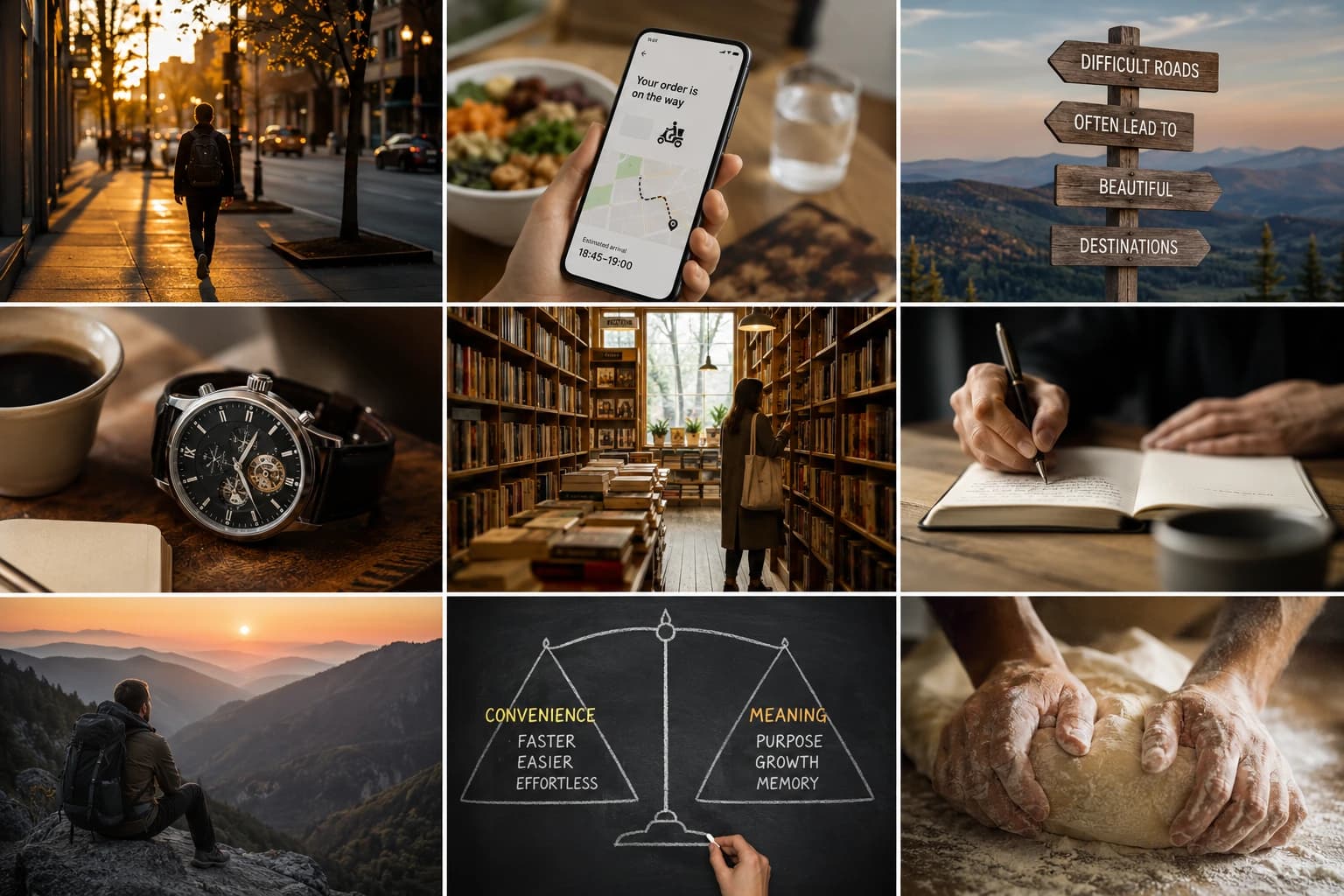
The Luxury of Difficulty
This helps explain an apparent contradiction in wealthy societies.
As convenience increases, people frequently pay money to reintroduce difficulty.
They drive to gyms to lift objects that do not need to be moved.
They pay for wilderness retreats without Wi-Fi.
They buy mechanical watches that are objectively worse at telling time than their phones.
They bake sourdough bread that requires hours of attention despite living minutes away from supermarkets.
They run ultramarathons.
They learn instruments they will never professionally perform.
They garden.
They camp.
They assemble furniture.
They knit.
They make espresso with machines requiring a bizarre amount of maintenance for a beverage that could be obtained by pressing a button.
These activities make little sense if human beings are fundamentally trying to minimize effort.
But perhaps effort is not the enemy.
Meaningful effort may actually be one of the ingredients of satisfaction.
The psychologist Mihaly Csikszentmihalyi famously studied "flow": the state in which a person becomes deeply absorbed in an activity whose difficulty is closely matched to their abilities.
Too little challenge produces boredom.
Too much produces anxiety.
Somewhere in between is engagement.
The convenience economy is optimized around a different goal: reducing the distance between wanting and receiving.
But satisfaction may depend partly on that distance.
Anticipation needs time.
Mastery needs resistance.
Pride needs difficulty.
Stories need obstacles.
Even memory seems to prefer events that contain variation, surprise and emotional intensity over perfectly smooth experiences.
A completely frictionless vacation might be pleasant.
It may also be strangely forgettable.
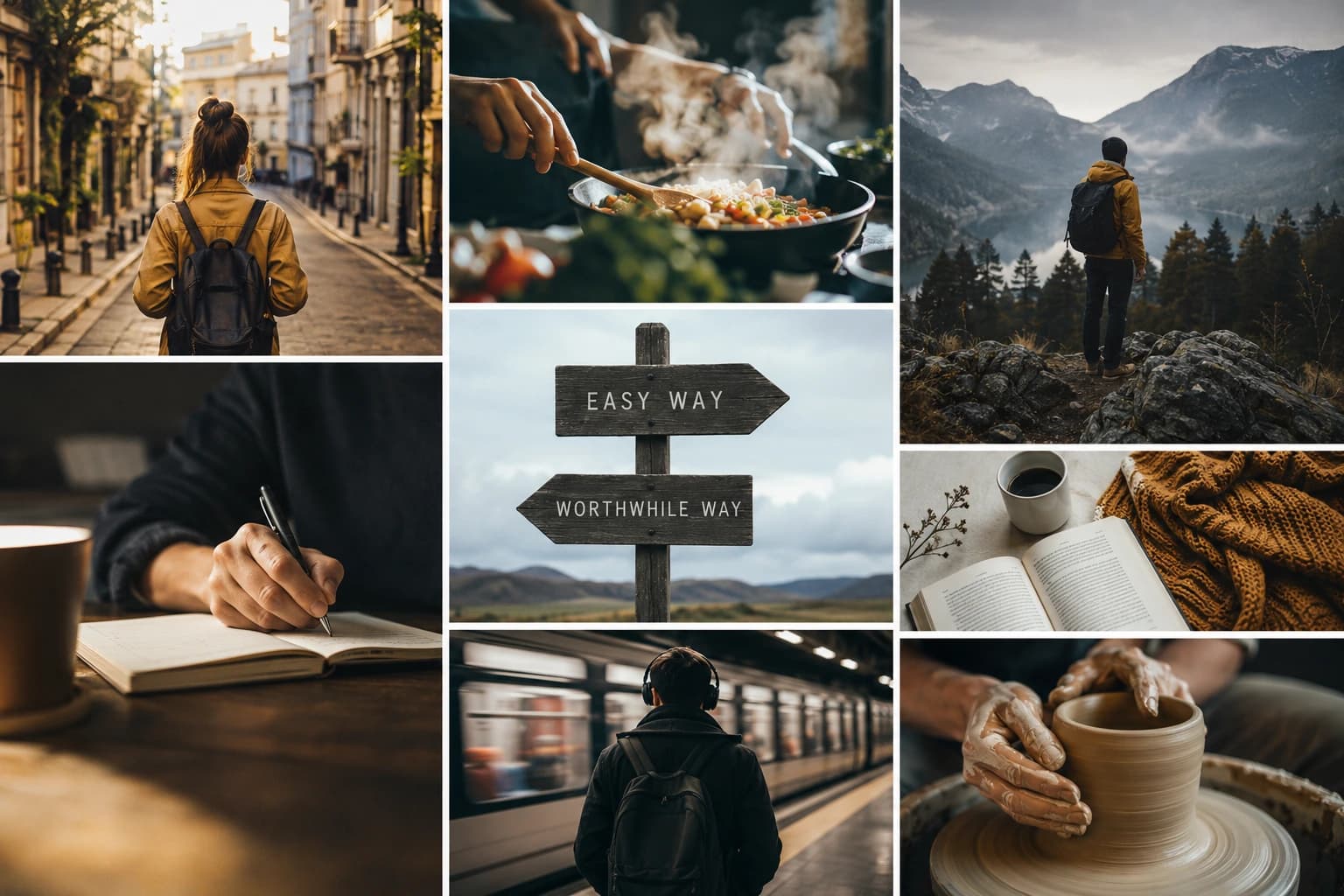
The Real Status Symbol May Become Agency
For most of history, convenience was a luxury.
The wealthy had servants. They avoided manual labor. Others cooked, cleaned, carried, arranged and traveled on their behalf.
Industrialization democratized portions of that privilege. Technology accelerated the trend. Today, an ordinary smartphone owner possesses forms of convenience that emperors could not have imagined.
This creates an interesting possibility.
Once convenience becomes abundant, inconvenience can become scarce.
And scarce things often acquire status.
We can already see versions of this.
Mass-produced food is cheap; handmade food commands a premium.
Instant digital communication is universal; handwritten letters feel significant.
Infinite streaming music costs almost nothing; vinyl records sell partly because they make listening less convenient.
Fast fashion is abundant; craftsmanship is expensive.
Automated recommendations are everywhere; trusted human curation feels distinctive.
As artificial intelligence makes competent output increasingly cheap, another scarce resource may become more valuable:
evidence that a human being cared enough to do something deliberately.
Not because machines cannot produce beauty.
They can.
But because abundance changes what we notice.
When photographs were expensive, taking a photograph demonstrated intention.
When photographs became nearly free, we began taking thousands.
The photograph did not disappear. Its informational value changed.
Something similar may happen to writing, illustration, software, music and design.
If competent production becomes nearly effortless, difficulty itself may become a signal.
The question "Is this good?" may gradually be joined by another:
"Why did someone bother to make this?"
The Goal Is Not to Reject Convenience
There is an easy but unhelpful conclusion to all of this: technology is making us passive, therefore we should return to some romanticized pre-digital life.
That argument misunderstands the problem.
Convenience is one of civilization's greatest achievements.
Washing machines liberated enormous amounts of domestic labor.
Online banking eliminated pointless errands.
Modern navigation saves fuel, time and lives.
Translation software allows people to communicate across languages.
Automation removes repetitive work.
AI can help people learn, create and solve problems at extraordinary speed.
The question is not whether convenience is good.
The question is where convenience belongs.
There are tasks whose value lies almost entirely in the outcome.
Few people need the spiritual experience of manually calculating their taxes.
There are other activities whose value lies partly in the process.
Learning.
Thinking.
Making.
Exploring.
Building relationships.
Developing taste.
Raising children.
Practicing a craft.
Understanding yourself.
When we apply the logic of convenience indiscriminately to both categories, we risk optimizing away the very thing we wanted.
A Better Question Than "Can This Be Easier?"
Perhaps the defining question of the last technological era was:
Can we make this easier?
It produced extraordinary companies, products and infrastructure.
The defining question of the next era may need to be more nuanced:
Which difficulties are worth keeping?
That question applies to technology designers, but it also applies to individual lives.
Which things should you continue remembering instead of storing?
Which journeys should you navigate without instructions?
Which conversations deserve a phone call instead of a message?
Which meals should take an hour?
Which problems should you struggle with before asking an AI?
Which recommendations should you ignore?
Which skills should remain inefficient simply because practicing them makes you more capable?
These decisions will increasingly become acts of self-design.
Because the default environment will almost always move in the opposite direction.
Someone will offer to choose faster.
Someone will offer to deliver sooner.
Someone will offer to predict better.
Someone will offer to remove another click, another walk, another conversation, another moment of uncertainty.
Most of these offers will genuinely improve our lives.
But occasionally, the most valuable thing we can do is decline.
Not because difficulty is virtuous by itself.
Because a life with no resistance has a strange consequence:
You may arrive everywhere faster while becoming less certain that you chose the destination.
And in an age increasingly capable of removing every obstacle between desire and satisfaction, deliberately choosing what remains difficult may become one of the clearest expressions of freedom we have left.

Loading the conversation…