
Dr. Thiru Jeevanandam was the first Indian engineer to receive a Japanese working visa. His journey from Pollachi, Tamil Nadu, would lead to a long career at Yokogawa Electric and a continuing role guiding Indian students and professionals in Japan.
“It took almost nine months to get a work visa.”
Dr. Thiru Jeevanandam recalled that wait in a 2017 interview with Japan SPOTLIGHT. He joined Yokogawa Electric in April 1987, beginning a chapter of his life in Japan that would span decades.
For someone considering an engineering career overseas, those nine months are a striking detail. An offer had opened a possibility; getting there still required patience. Jeevanandam's subsequent career would connect him to industrial engineering, business development and a growing community of Indian professionals in Japan.
From Pollachi to engineering research
Jeevanandam completed his Bachelor of Engineering at PSG College of Technology, Coimbatore, in 1972, followed by a Master of Engineering at the same institution in 1974. He went on to complete his PhD at the Indian Institute of Technology Delhi in 1981.
Before moving to Japan, he worked as a Systems Manager at Engineers India Limited in New Delhi from 1979 to 1987. His LinkedIn career profile describes a specialisation in real-time computer applications for process industries and pipeline SCADA, the systems used to monitor and control pipeline operations. That work connected his academic training with the demands of operating industrial facilities.
His connection with Yokogawa began through work. In his Japan SPOTLIGHT interview, he explained that he had handled the Japanese company's automation products and systems at an engineering consultancy in Delhi. The relationship eventually led to a job offer. He had also visited Japan as a customer in 1983, four years before joining the company.
The sequence matters: a working relationship preceded the move. His experience offers a concrete example of how technical collaboration can develop into an international career.
Engineering for industry and energy
Jeevanandam's long career at Yokogawa included service as Chief Technology Officer at its Global Power System Center. His career profile describes work in renewable energy applications and advanced process control for coal-fired power plants. His industrial automation experience also covered oil and gas facilities and petrochemical plants, giving his work a reach across several parts of the energy and process industries.
The profile also records feasibility work on more than 15 projects intended to progress toward registration under the United Nations Framework Convention on Climate Change's Clean Development Mechanism. His international experience included work on gas-fired power and heat generation plants in Russia. These details add substance to the leadership title: his career involved the technical and feasibility questions behind industrial energy projects.
A career connecting two countries
His work also extended to helping establish Yokogawa's Indian operations, according to the biographical account supplied to BM Journal.
Yokogawa India's company overview dates its establishment to 1987 and describes its engineering and manufacturing centres in Bengaluru. The same year that marked Jeevanandam's move to Japan was therefore also an important year in the company's presence in India.
Seen together, these two strands give his story a wider interest. He built his professional life in Japan while contributing to a business connection with India. For readers thinking about working overseas, that is a useful possibility to consider: an international career can create opportunities to contribute in more than one country.
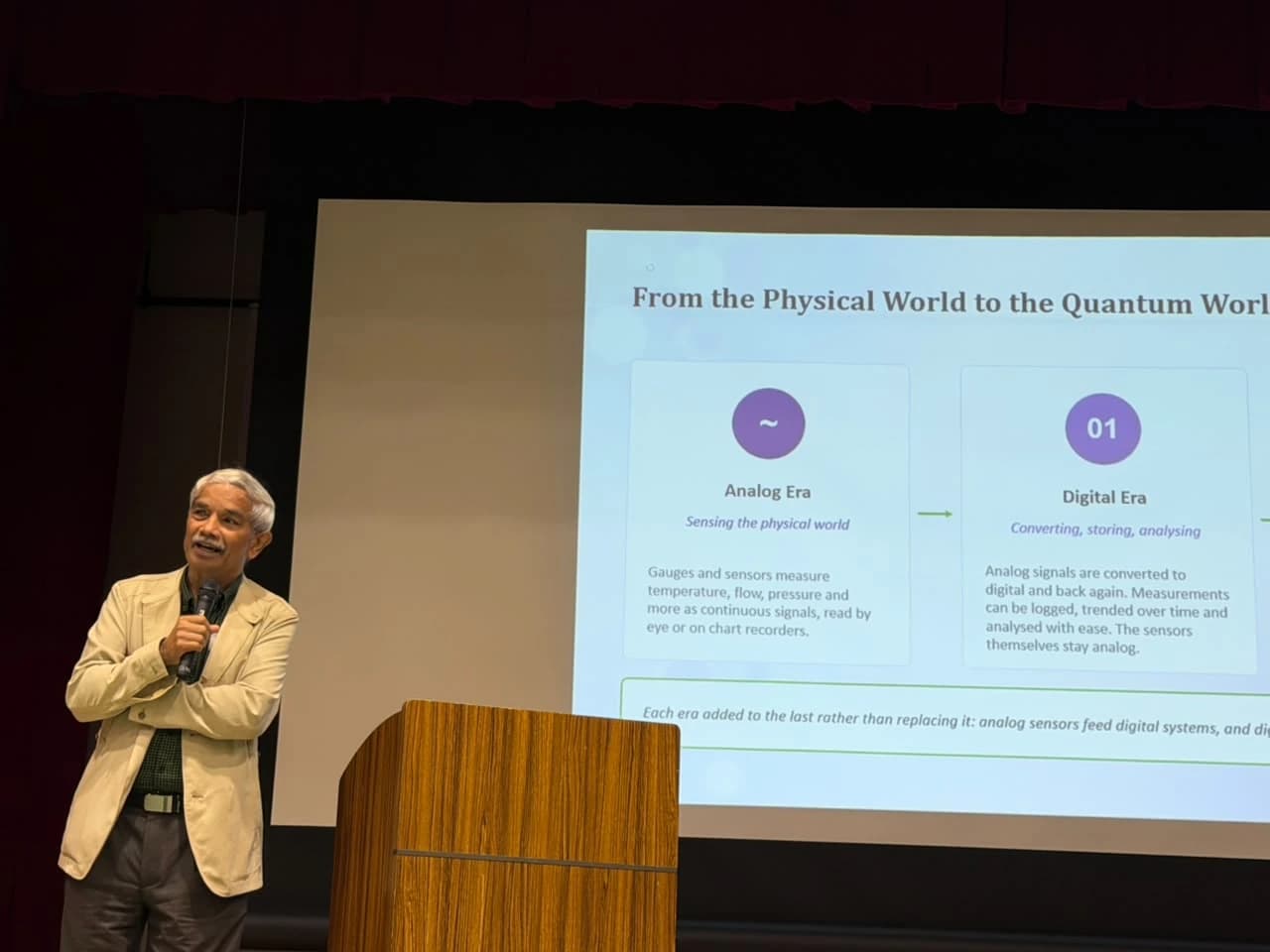
 Dr. Thiru Jeevanandam speaking at a PSG-branded lectern. Photograph supplied to BM Journal.
Experience shared with the next generation
Following his retirement from Yokogawa, Jeevanandam remains based in Japan and continues to guide students and professionals exploring careers there.
The affection surrounding that role comes through in Parthasarathy's alumni account. He refers to Jeevanandam as “Dr Jeeva Sir” and describes him listening to others before offering guidance. It is a small observation, but a revealing one: within this community, his experience remains part of an ongoing conversation.
For someone weighing a move abroad, access to a person with decades of experience can make unfamiliar choices easier to discuss. Questions about work, study and building a life in another country become more tangible when there is someone to ask.
From Pollachi to PSG, IIT Delhi and Yokogawa, Jeevanandam's journey has covered institutions, industries and borders. Through his mentorship, that experience continues to reach people preparing for journeys of their own.



Loading the conversation…