
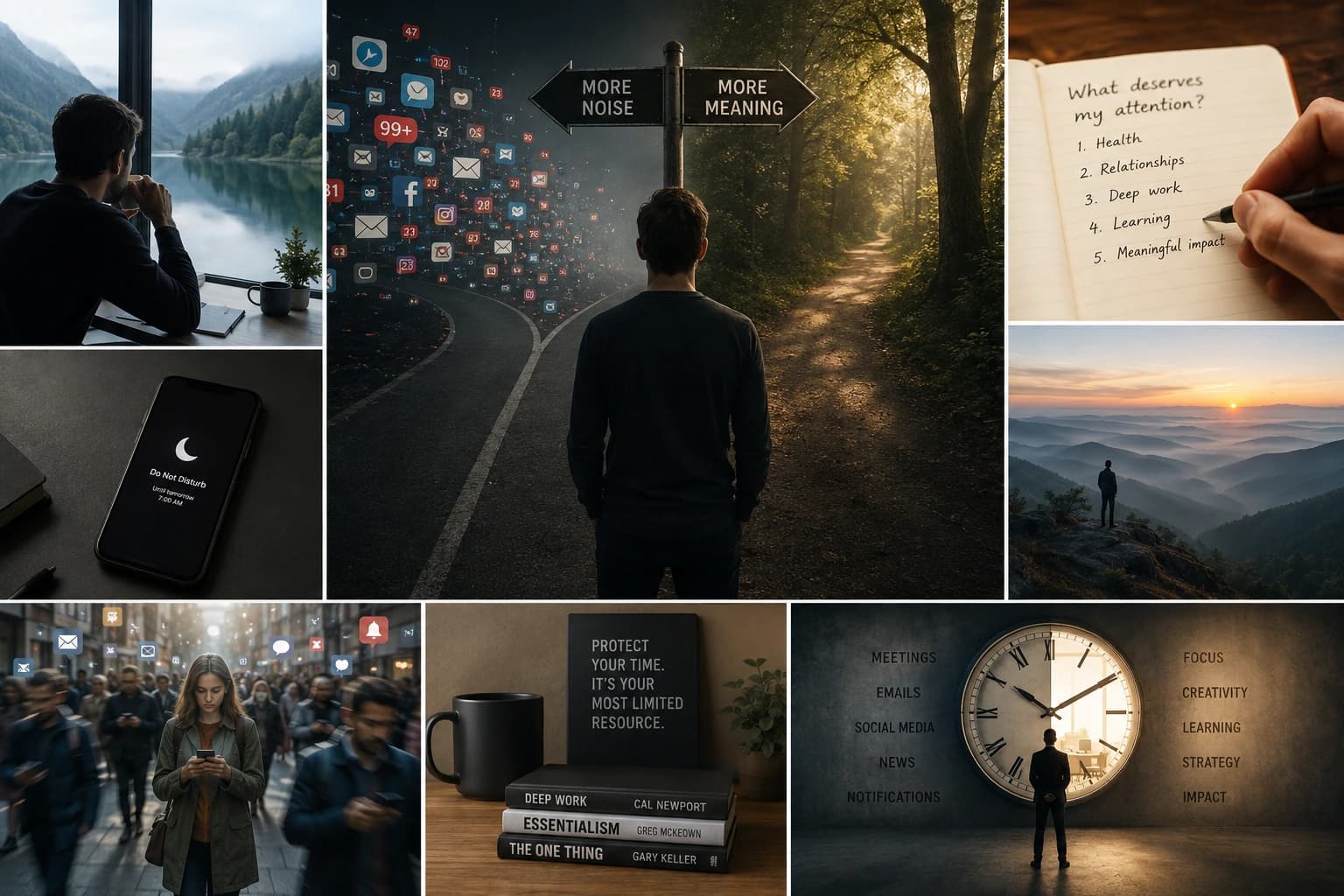
There is a peculiar contradiction at the center of modern life.
We have engineered away enormous amounts of friction. Food arrives without a trip to the store. A car appears after three taps. Entertainment begins before boredom has time to fully form. Software writes, sorts, recommends, reminds, routes, predicts, and completes. The number of small inconveniences a wealthy society can eliminate is extraordinary.
And yet many people do not feel as though they have gained time.
They feel behind.
This is not merely a complaint about smartphones, nor another sermon about deleting social media. It is a deeper economic problem. Over the past two decades, we have become exceptionally good at reducing the cost of accessing things while simultaneously increasing the cost of paying attention to them.
The internet made information abundant. Artificial intelligence is making production abundant. Distribution is already nearly free.
What remains scarce is the human capacity to decide what deserves concentration.
That scarcity may become one of the defining inequalities of the next decade.
The Old Scarcity Was Access
For most of history, access was expensive.
Books were scarce. Expertise was geographically concentrated. Entertainment required physical infrastructure. Research demanded institutional affiliation. Starting a business required capital, distribution, employees, and often permission from a long chain of intermediaries.
The internet changed that.
A teenager with a laptop can learn calculus from world-class instructors, study advertising campaigns from multinational companies, watch university lectures, read government filings, download open-source software, publish globally, and sell products to people she has never met.
Artificial intelligence pushes this transition further.
Producing a respectable first draft of an email, presentation, marketing campaign, software prototype, research summary, or business plan is rapidly becoming cheaper. The technical barrier separating an idea from an initial artifact is collapsing.
This sounds like an uncomplicated expansion of opportunity.
It isn't.
When everyone gains access to powerful tools, the competitive advantage moves elsewhere.
If information is plentiful, knowing what not to read matters.
If content is easy to produce, knowing what deserves to exist matters.
If ideas can be generated instantly, developing judgment about which idea is worth pursuing matters.
And if everyone can create more, the person capable of ignoring most of it acquires an unusual advantage.
The scarce resource migrates.
We are moving from an economy constrained by access toward one constrained by attention.
Convenience Has a Hidden Price
Modern technology often advertises itself in units of saved time.
Order groceries online: save 40 minutes.
Use AI to summarize a report: save 20 minutes.
Take a rideshare instead of public transport: save 15 minutes.
Automate an administrative process: save three hours a week.
Individually, these gains are real.
But something strange happens to the saved time.
It rarely accumulates.
A person who saves five hours through technology does not usually discover five pristine hours waiting at the end of Friday. The time is absorbed by additional communication, more consumption, more commitments, and the rising expectations that accompany faster tools.
Email is a classic example.
Digital communication drastically reduced the cost of sending a message. The result was not a civilization that spent less time communicating. It was a civilization that sent vastly more messages.
Lower the cost of an activity and people frequently consume more of it.
Economists recognize this pattern in other areas. More efficient engines can reduce the cost of driving and encourage people to drive farther. Faster computers make calculations cheaper and inspire applications requiring vastly more computation.
Attention behaves similarly.
Make communication instantaneous, and communication multiplies.
Make content creation effortless, and content multiplies.
Make meetings easier to schedule, and meetings multiply.
Make information easier to find, and the amount people believe they should know expands.
Efficiency does not automatically produce leisure.
Sometimes it produces volume.
The Great Reversal
For decades, knowledge workers were rewarded for having access to information.
They knew the right people. They subscribed to expensive databases. They possessed specialized technical knowledge. They had access to research departments, libraries, terminals, analysts, or proprietary software.
Increasingly, that advantage is disappearing.
The emerging advantage is almost the reverse.
The valuable worker is not necessarily the person who can obtain the most information.
It is the person who can discard the most irrelevant information without anxiety.
That requires judgment.
Consider two analysts given access to the same powerful AI system.
The first produces 60 pages of research, 23 charts, 14 strategic possibilities, and a comprehensive competitor analysis.
The second produces three pages.
The first may have worked harder.
The second may be more valuable.
Why?
Because organizations rarely suffer from an absolute shortage of possibilities. They suffer from an inability to distinguish consequential information from interesting information.
A good decision often requires fewer facts than people imagine.
The difficulty lies in identifying which facts.
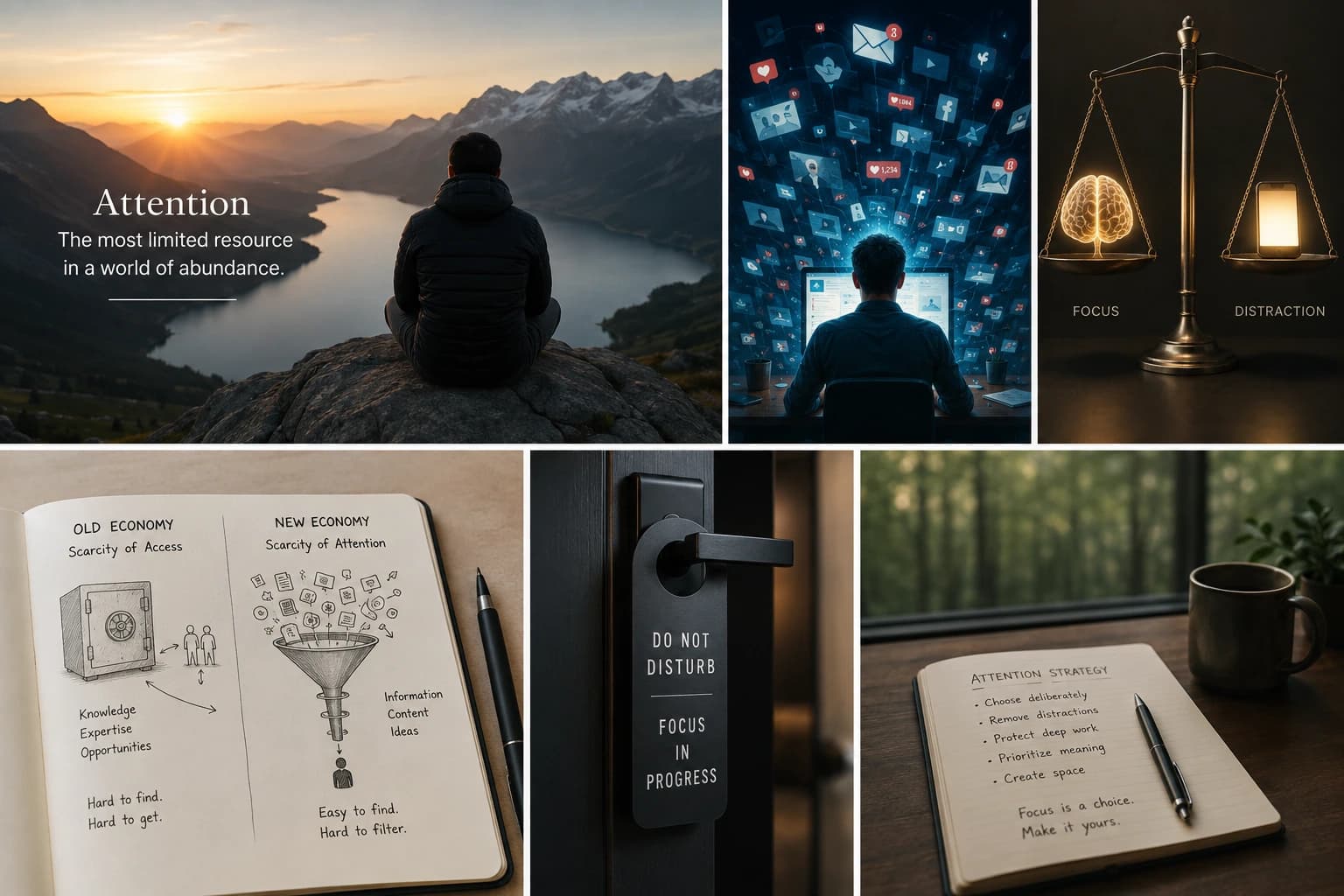
The Attention Market Has Unusual Incentives
There is another reason attention has become expensive: enormous businesses profit from capturing it.
Much of the digital economy operates through a deceptively simple mechanism.
First, create something useful enough that people return.
Then increase the frequency with which they return.
Then increase the amount of time they remain.
Then monetize the resulting behavior.
The user experiences a product.
The company sees an engagement curve.
These objectives occasionally align. Often they do not.
A navigation app benefits when you reach your destination quickly. A newspaper may benefit when you understand the world better.
But many digital products make more money when you remain engaged longer, open more frequently, react more strongly, or consume more items.
That distinction matters.
Imagine a restaurant whose business model depended not on satisfying your hunger but on maximizing the number of minutes you continued eating.
The menu would evolve differently.
Digital environments have evolved accordingly.
Notifications create urgency.
Infinite feeds eliminate stopping cues.
Recommendation systems reduce the small moment of effort required to choose what comes next.
Metrics transform social interaction into a visible scoreboard.
Short-form content compresses novelty into rapidly repeating intervals.
None of these mechanisms requires conspiracy. They emerge naturally from incentives.
If attention produces revenue, software will become increasingly sophisticated at acquiring attention.
The asymmetry is remarkable.
On one side sits an individual human brain carrying essentially the same cognitive architecture that existed thousands of years ago.
On the other sits a global optimization system trained on billions of interactions and refined by some of the world's most talented engineers.
The competition is not particularly fair.
Boredom Was Doing More Work Than We Realized
One casualty of this environment is boredom.
Boredom has acquired terrible branding. It sounds like a defect in the user experience.
But boredom performs an important cognitive function: it creates empty territory.
Until recently, ordinary life contained many involuntary gaps.
Waiting for a train.
Standing in a queue.
Sitting in a taxi.
Walking somewhere alone.
Waiting for a friend.
Lying awake for ten minutes.
These moments were not necessarily pleasant. But they gave thoughts room to collide without supervision.
Today, the smallest hint of mental vacancy can be eliminated immediately.
The phone provides something far more compelling than whatever uncertain thought might otherwise emerge.
This changes the texture of thinking.
Insight frequently requires a period during which nothing obviously productive is happening. Connections form indirectly. Problems are rehearsed without conscious effort. Half-developed ideas gain shape.
A culture that eliminates boredom may inadvertently eliminate some of the conditions under which original thought develops.
This matters more as AI improves.
When machines can produce competent answers instantly, human value increasingly shifts toward selecting unusual questions, forming original perspectives, noticing contradictions, and developing taste.
Those capacities are difficult to cultivate while constantly consuming the conclusions of other people.
Productivity Is Becoming the Wrong Metric
The language of productivity originated in industrial economics.
Output divided by input.
More units per hour.
Less waste.
Higher utilization.
These ideas work beautifully in factories.
They become dangerous when applied indiscriminately to human cognition.
Consider a founder deciding whether to enter a new market.
The most valuable thing she might do all week is spend four uninterrupted hours realizing that the company should not enter it.
No output is produced.
No task is completed.
No document necessarily exists.
Yet millions of dollars may have been saved.
Or consider a scientist abandoning an elegant hypothesis after noticing one inconvenient observation.
Or an investor deciding not to participate in a fashionable trade.
Or a writer deleting ten pages.
Or an executive canceling a project.
Traditional productivity systems struggle to account for these achievements because they measure visible activity more easily than intellectual restraint.
But increasingly, restraint is the point.
When generating output becomes cheap, generating more output becomes less impressive.
The premium moves toward selection.
AI Will Make This Problem Bigger
Much of the discussion about artificial intelligence focuses on whether machines will replace particular jobs.
A more immediate transformation may be simpler.
AI will dramatically increase the amount of reasonable-looking material that organizations can produce.
More proposals.
More software.
More research.
More campaigns.
More presentations.
More strategies.
More variations.
More ideas.
This is useful, but it creates a secondary problem.
Someone must evaluate all of it.
If producing ten strategic options once required a team for a week and now requires twenty minutes, companies will not necessarily settle for ten options.
They may request 100.
The bottleneck moves downstream.
Generation becomes cheap.
Evaluation becomes expensive.
This is why judgment is likely to become more valuable, not less.
The person who knows what good looks like gains leverage over increasingly powerful generative systems.
AI can amplify taste.
It cannot make the absence of taste irrelevant.
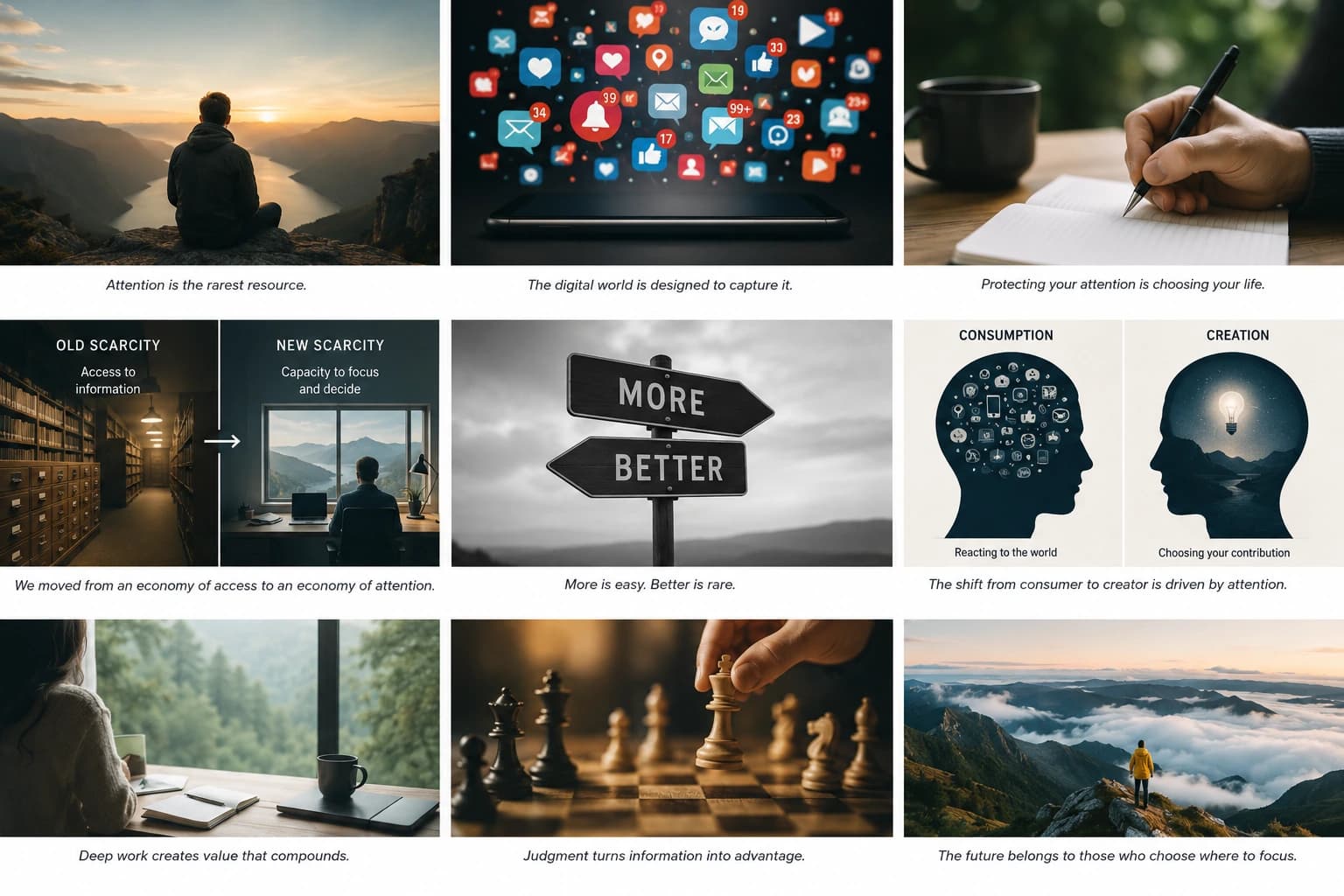
The New Status Symbol May Be Unavailability
For much of the digital era, responsiveness signaled importance.
Busy people answered quickly.
Executives carried multiple devices.
Professionals remained reachable.
Speed demonstrated seriousness.
That norm may eventually reverse.
As communication volume continues increasing, genuine concentration will require progressively stronger boundaries.
The ability to become unreachable for several hours may become a form of professional privilege.
You can already see fragments of this among people whose work depends heavily on judgment.
Writers retreat.
Engineers block mornings.
Investors read away from screens.
Executives establish meeting-free days.
Researchers disappear into laboratories.
The point is not aesthetic minimalism.
It is economic protection.
They are defending the resource from which their highest-value decisions emerge.
Eventually, organizations may treat uninterrupted attention the way factories treat electricity: critical infrastructure that cannot casually be disrupted.
There Will Be an Attention Divide
The most troubling possibility is that concentration becomes increasingly correlated with wealth.
Affluent people can already purchase environments that protect attention.
Quiet homes.
Private offices.
Childcare.
Assistants.
Noise-canceling headphones.
Flexible schedules.
Shorter commutes.
Better schools.
Fewer advertisements.
Paid software without interruptions.
Access to nature.
Time away.
People with fewer resources often encounter the opposite: unpredictable schedules, crowded environments, administrative complexity, multiple jobs, financial stress, longer commutes, and digital services optimized aggressively for monetization.
The future inequality may therefore involve something more subtle than access to technology.
Almost everyone may possess extraordinary digital tools.
But not everyone will possess the conditions necessary to use them deliberately.
The wealthy may buy silence while everyone else receives notifications.
Protecting Attention Requires More Than Discipline
It is tempting to turn this into a self-help problem.
Wake up earlier.
Meditate.
Delete apps.
Use grayscale mode.
Buy a notebook.
These tactics can help.
But describing the problem entirely in terms of individual discipline misunderstands the scale of the forces involved.
Environment usually beats willpower.
A casino does not depend on customers making a conscious decision every four minutes to continue gambling. The environment is designed so that continuing feels natural.
Digital environments work similarly.
The most effective strategy is therefore not heroic self-control.
It is architecture.
Remove notifications rather than resisting them.
Keep distracting devices physically distant rather than repeatedly deciding not to touch them.
Create hours in which colleagues know responses will not arrive.
Schedule uninterrupted work before scheduling meetings.
Choose information sources deliberately instead of entering algorithmic feeds without an objective.
Establish stopping rules.
The goal is to eliminate decisions about attention wherever possible.
Because every decision is another opportunity to lose.
The Highest Form of Wealth
We usually define wealth as possessing things.
Money.
Property.
Assets.
Access.
But wealth can also be understood as control over one's time and consciousness.
Can you decide what you think about for the next three hours?
Can you spend an afternoon reading something difficult without interruption?
Can you walk for an hour without becoming reachable?
Can you investigate an idea that has no immediate economic justification?
Can you sit quietly long enough to discover what you actually believe?
These questions sound philosophical.
They are becoming economic.
A person capable of sustained concentration can acquire skills faster, solve harder problems, produce more original work, notice subtle opportunities, and make decisions with less dependence on whatever happens to be circulating through the information environment.
That person possesses a form of capital.
It compounds.
The Future Will Produce More of Everything
More videos will be published tomorrow than you could consume in several lifetimes.
More articles will appear.
More podcasts.
More software.
More investment opportunities.
More newsletters.
More synthetic media.
More recommendations.
More messages.
More intelligent machines offering more possible answers.
The central question of the information age was once:
How do I find what I need?
The central question of the next era may be:
What deserves my attention at all?
That sounds like a small distinction.
It is not.
Civilizations are shaped partly by what they make abundant and partly by what remains scarce after abundance arrives.
Industrialization made physical goods abundant and increased the value of services.
The internet made information abundant and increased the value of reputation and filtering.
Artificial intelligence may make cognitive production abundant.
If so, the scarce assets will be judgment, taste, trust, and attention.
Machines will generate.
Networks will distribute.
Algorithms will recommend.
But someone will still have to decide.
The most powerful person in the room may eventually be the one capable of looking at an infinite number of possibilities and saying:
No. This one.


Loading the conversation…