
There is a peculiar feature of modern life that almost nobody notices until it has already become expensive.
The things competing hardest for our attention are usually free.
The news alert costs nothing. The social feed costs nothing. The video playing automatically after the video you actually wanted to watch costs nothing. The inbox can be refreshed indefinitely. The group chat is free. The recommendation algorithm never sends an invoice.
And yet people increasingly describe themselves as exhausted, distracted, behind, anxious, and strangely unable to finish the things they claim matter most to them.
This is not a contradiction.
It is the business model.
For most of economic history, scarcity was visible. Land was scarce. Food was scarce. Machinery was scarce. Capital was scarce. If something was valuable, its limited supply was usually obvious.
In the digital economy, one of the most valuable scarce resources is hidden inside your skull.
It is your capacity to decide what deserves your mind.
The companies that understand this have become extraordinarily powerful. The individuals who understand it may have an equally important advantage.
Attention Is Not Time
People often talk about attention as though it were merely another word for time.
It isn't.
You can have three free hours and accomplish almost nothing. You can have forty focused minutes and solve a problem that has followed you for weeks.
Time describes duration.
Attention describes what your cognitive machinery is permitted to work on during that duration.
That distinction matters because most meaningful work has what economists might call a high activation cost. Writing the difficult proposal, understanding an unfamiliar technical problem, making a consequential decision, studying a complex subject, designing something original—these activities rarely begin at full speed.
The mind has to load the problem.
Names, facts, constraints, relationships, unanswered questions and half-formed ideas must all be brought into working memory. Only then does deeper thinking begin.
Interruptions destroy part of that loading process.
This means a ten-second distraction does not necessarily cost ten seconds.
It may cost the entire mental state you had spent twenty minutes constructing.
The modern knowledge worker therefore lives inside a strange productivity trap: we measure work in hours while destroying it in fragments.
The Factory Has Moved Inside Your Head
Industrial capitalism organized physical labor.
Digital capitalism increasingly organizes perception.
The factory of the twentieth century had machinery, assembly lines and supervisors. The factory of the twenty-first century often looks like a smartphone screen.
Its raw material is human attention.
Its optimization systems are extraordinarily sophisticated.
Every notification creates a tiny decision.
Open or ignore?
Every headline creates another.
Read or continue?
Every message produces another unresolved thread.
Respond now or remember later?
Individually, these decisions feel trivial. Collectively, they create a background tax on cognition.
The result is a population of people who are rarely doing nothing but are frequently accomplishing less than they expected.
This is why busyness has become such a misleading signal.
A person can send sixty messages, attend five meetings, read twelve articles, answer thirty emails and end the day with the uneasy realization that nothing important actually moved.
Activity has become abundant.
Progress remains scarce.

The Attention Economy Discovered a Dangerous Truth
Human beings are not naturally good at ignoring novelty.
For our ancestors, novelty could contain useful information.
A movement in the grass mattered.
A sudden sound mattered.
A change in another person's expression mattered.
The nervous system evolved accordingly.
Modern software did not create this sensitivity. It industrialized it.
The most successful digital products are not necessarily those we consciously value most. They are often those that become exceptionally good at triggering return behavior.
There is an enormous difference.
Something can be irresistible without being valuable.
Potato chips demonstrated this principle for food long before infinite scroll demonstrated it for information.
In both cases, engineering can separate desire from nourishment.
The information version may be more consequential because the consumption is invisible. Nobody looks down after forty-five minutes of switching between apps and sees an empty bag.
There is no physical evidence of what was consumed.
Only missing time.
The Great Status Reversal
For centuries, wealthy people demonstrated status through access.
They could obtain what others could not.
Today, abundance has reversed part of that equation.
Everyone can access nearly unlimited entertainment, commentary, news, opinions, music, video and conversation.
The emerging luxury is not access.
It is exclusion.
A quiet room.
An afternoon without meetings.
A phone that is not vibrating.
An inbox someone else filters.
A calendar with empty space.
A mind allowed to remain on one problem long enough to understand it.
The wealthy have begun purchasing what technology removed from everyone else: uninterrupted attention.
Executive assistants protect calendars.
Private offices protect concentration.
Luxury resorts advertise disconnection.
Premium cabins create physical separation.
Retreats sell silence.
What appears to be the purchase of space is frequently the purchase of cognitive sovereignty.
The next major status symbol may therefore be invisible.
It will be the ability to be unreachable.
Why Smart People Are Particularly Vulnerable
Intelligent people sometimes assume they are immune to distraction because they can process information quickly.
The opposite may occasionally be true.
A curious mind sees potential value everywhere.
An interesting article might contain an important idea.
A new message might reveal an opportunity.
A podcast might teach something useful.
A notification might matter.
The intellectually ambitious person therefore has trouble closing doors.
But extraordinary work often requires precisely that.
It requires tolerating the possibility that something interesting is happening elsewhere.
This is one of the hidden psychological costs of concentration.
To focus deeply on one thing, you must repeatedly decline other things that might also be worthwhile.
Focus is therefore less about discipline than exclusion.
The person who attempts to consume every valuable piece of information eventually loses the ability to produce much of value.
Information Has a Metabolism
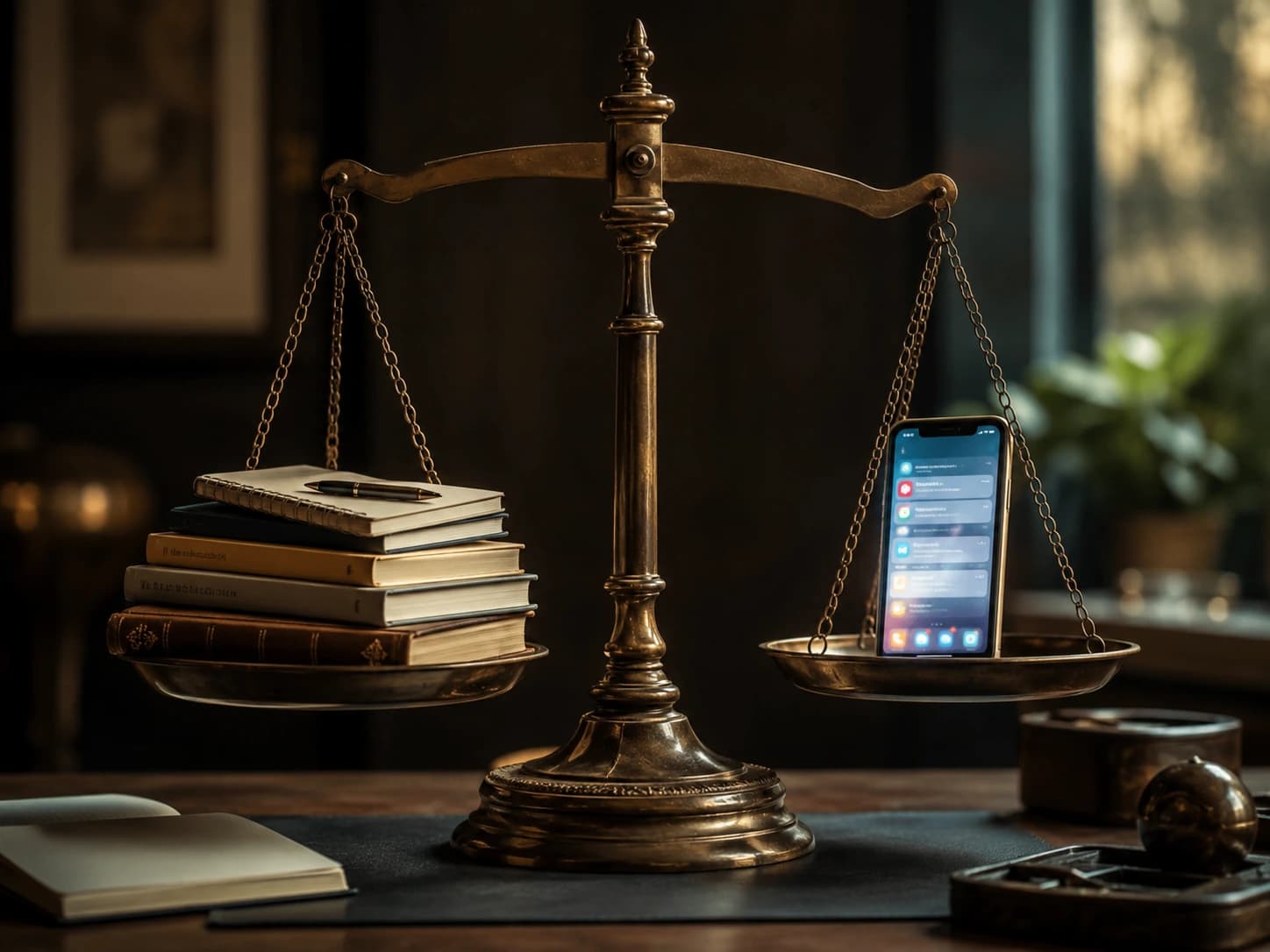
There is another misconception embedded in modern productivity culture: that consuming useful information is automatically productive.
It isn't.
Information has to be metabolized.
Imagine reading five excellent books about investing in a month.
You underline passages. Save quotations. Highlight ideas. Recommend the books to friends.
But six months later, your portfolio, savings behavior and financial decisions are unchanged.
What exactly did the information accomplish?
The problem is not unique to books.
We increasingly confuse recognition with understanding.
An idea feels familiar, so we assume we know it.
We save an article, so we feel as though we have captured its value.
We bookmark a tutorial, creating the psychological impression of future competence.
We watch someone explain a skill, briefly borrowing their clarity.
Consumption creates a simulation of progress.
Application reveals whether progress actually occurred.
This distinction explains why a person can spend years consuming high-quality material without becoming unusually capable.
Their information diet may be excellent.
Their conversion rate is terrible.
The Compounding Value of Long Thoughts
The most valuable ideas often require unusually long periods of uninterrupted thought because insights are rarely isolated objects.
They are combinations.
A person notices something in economics, remembers something from biology, connects it to a problem in software, and suddenly sees a pattern that was invisible when the ideas were separate.
That combination requires mental residency.
The relevant concepts must remain in the mind simultaneously long enough to collide.
Fragmented attention lowers the probability of those collisions.
This may be one reason genuinely original thinking feels rarer than information availability would predict.
Humanity has access to more knowledge than any previous civilization.
Yet access alone does not produce insight.
A library does not become intelligent merely because it contains books.
Neither does a brain.
Knowledge becomes powerful when it is organized, questioned, compared and recombined.
Those processes require something the internet is structurally designed to interrupt:
continuity.

Your Inputs Eventually Become Your Thoughts
People protect their food more carefully than their informational environment.
They read ingredient labels.
They avoid contaminated water.
They worry about sugar, chemicals, allergens and calories.
Then they allow virtually anyone with an algorithmic distribution system to enter their consciousness.
This is strange because information has downstream effects.
What you repeatedly consume changes what appears important.
What appears important changes what you think about.
What you think about changes what you notice.
What you notice influences what you believe.
And what you believe eventually influences how you act.
Attention is therefore upstream of identity.
This does not mean people should construct ideological bubbles or avoid uncomfortable information. Quite the opposite. A deliberately designed information environment should contain disagreement, complexity and surprise.
But deliberate exposure is different from indiscriminate exposure.
One is a diet.
The other is grazing.
The Power of Being Difficult to Reach
There is an increasingly valuable professional characteristic that rarely appears on résumés:
the ability to disappear temporarily.
Not permanently.
Not irresponsibly.
Just long enough to think.
Consider two workers.
The first responds to nearly every message within five minutes. They attend almost every meeting. They monitor multiple channels continuously. Their colleagues describe them as responsive.
The second is slower to reply. They protect blocks of time. They decline meetings without clear purposes. They sometimes vanish for two hours.
But when difficult work arrives, the second person repeatedly produces unusually strong answers.
Most organizations claim to value the second outcome while designing systems that reward the first behavior.
Green status indicators are visible.
Deep thought is not.
Fast replies are measurable.
Avoided mistakes are not.
Meeting attendance is recorded.
Insight has no timestamp.
This creates a management problem disguised as a productivity problem.
If institutions reward responsiveness more visibly than judgment, people will gradually optimize for responsiveness.
Then everyone will wonder why strategic thinking has disappeared.
Boredom Is Becoming a Competitive Advantage
One of the strangest consequences of constant stimulation is that boredom now feels like a technical malfunction.
A queue forms.
The phone appears.
An elevator door closes.
The phone appears.
A friend leaves the table for ninety seconds.
The phone appears.
We have nearly eliminated the unoccupied moments in which the mind once wandered.
This sounds like progress until you remember what wandering minds do.
They replay conversations.
Notice contradictions.
Formulate questions.
Imagine futures.
Recognize emotions.
Connect ideas.
Create plans.
In other words, some of the cognitive processes we claim to value occur precisely when nothing else is demanding our attention.
The elimination of boredom may therefore have unintended intellectual consequences.
A person who cannot tolerate ten unstimulated minutes will struggle to remain with a difficult question whose answer does not arrive immediately.
And increasingly, that patience will distinguish people.
When distraction becomes universal, concentration becomes asymmetric.
When everyone can generate information, judgment becomes scarce.
When everyone can publish, taste becomes valuable.
When everyone can react instantly, the person capable of waiting and thinking acquires leverage.
The Personal Economics of Attention
You can think of your waking life as an investment portfolio.
Every hour allocates cognitive capital.
Some allocations produce almost no future return.
Some create temporary pleasure.
Some maintain relationships.
Some restore energy.
Some build capabilities that compound for decades.
The mistake is not spending attention on entertainment. Recreation has value.
The mistake is spending attention unconsciously.
An hour chosen deliberately and an hour surrendered accidentally may look identical on a clock, but psychologically they are completely different experiences.
Agency changes the value of time.
This suggests a useful question that is more powerful than most productivity systems:
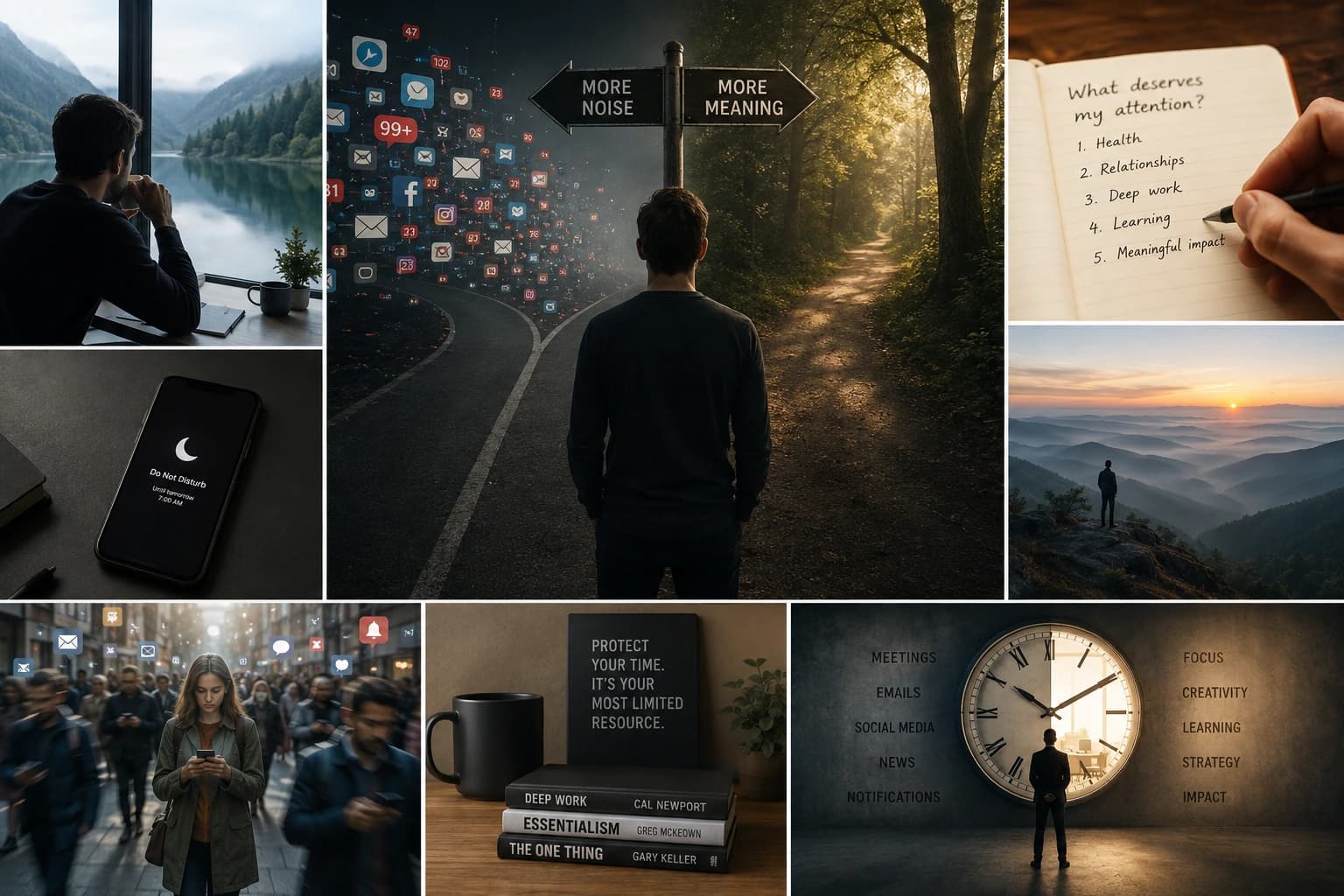
What deserves the best hours of my brain?
Not the leftover hours.
Not the hours after messages.
Not the hours after meetings.
The best ones.
If your most cognitively valuable period each day is routinely consumed by other people's requests, your priorities exist mostly as statements.
Your calendar is telling the truth.
A Different Definition of Wealth
Traditional wealth increases your ability to acquire things.
A deeper form of wealth increases your ability to refuse them.
You can refuse the unnecessary meeting.
Refuse the compulsive refresh.
Refuse the manufactured urgency.
Refuse the expectation of constant availability.
Refuse information that has no meaningful relationship to your life.
Refuse to convert every empty moment into consumption.
This is not minimalism for its own sake.
It is resource allocation.
There are only so many problems you will think deeply about in one lifetime.
Only so many books you will absorb rather than merely finish.
Only so many relationships you can understand.
Only so many crafts you can master.
Only so many ideas you can develop far enough to become genuinely yours.
The constraint is not access.
It is attention.
And the uncomfortable truth is that nobody can protect yours entirely on your behalf.
Every powerful system around you has incentives.
Media companies want another minute.
Employers want another response.
Platforms want another session.
Advertisers want another impression.
Creators want another view.
Friends want another message.
Most of these demands are individually reasonable.
Together, they can consume a life.
So perhaps the essential modern skill is not productivity.
It is sovereignty.
The ability to decide, repeatedly and deliberately, what enters your mind, what remains there, and what deserves enough uninterrupted time to become something more than noise.
The future will continue producing more information than anyone can absorb.
More entertainment than anyone can watch.
More opinions than anyone can evaluate.
More opportunities than anyone can pursue.
More people worth knowing than anyone can know.
Abundance will keep expanding.
Your attention will not.
Which means the central question of the coming decades may not be what information you can access.
It may be something much more personal:
What are you willing to ignore?


Loading the conversation…