
For most of modern economic history, progress has meant removing friction.
Faster checkout. Faster delivery. Faster communication. Faster entertainment. Faster food. Faster decisions.
The ideal product became one that asked almost nothing of you.
One click. One tap. No waiting. No learning curve.
That logic produced some of the most successful companies of the past twenty years. Amazon reduced the distance between wanting and owning. Spotify reduced the distance between remembering a song and hearing it. Uber reduced the distance between deciding to leave and having a car appear. Social media reduced the distance between boredom and stimulation to roughly the time it takes a thumb to move three centimeters.
Convenience won.
And now, almost imperceptibly, the status hierarchy is beginning to reverse.
The scarce thing is no longer access.
It is friction.
Not pointless friction—bureaucracy, bad design, standing in line for no reason—but chosen friction: the deliberate introduction of effort, time, ritual, expertise, waiting, and limitation into experiences that technology could theoretically make instantaneous.
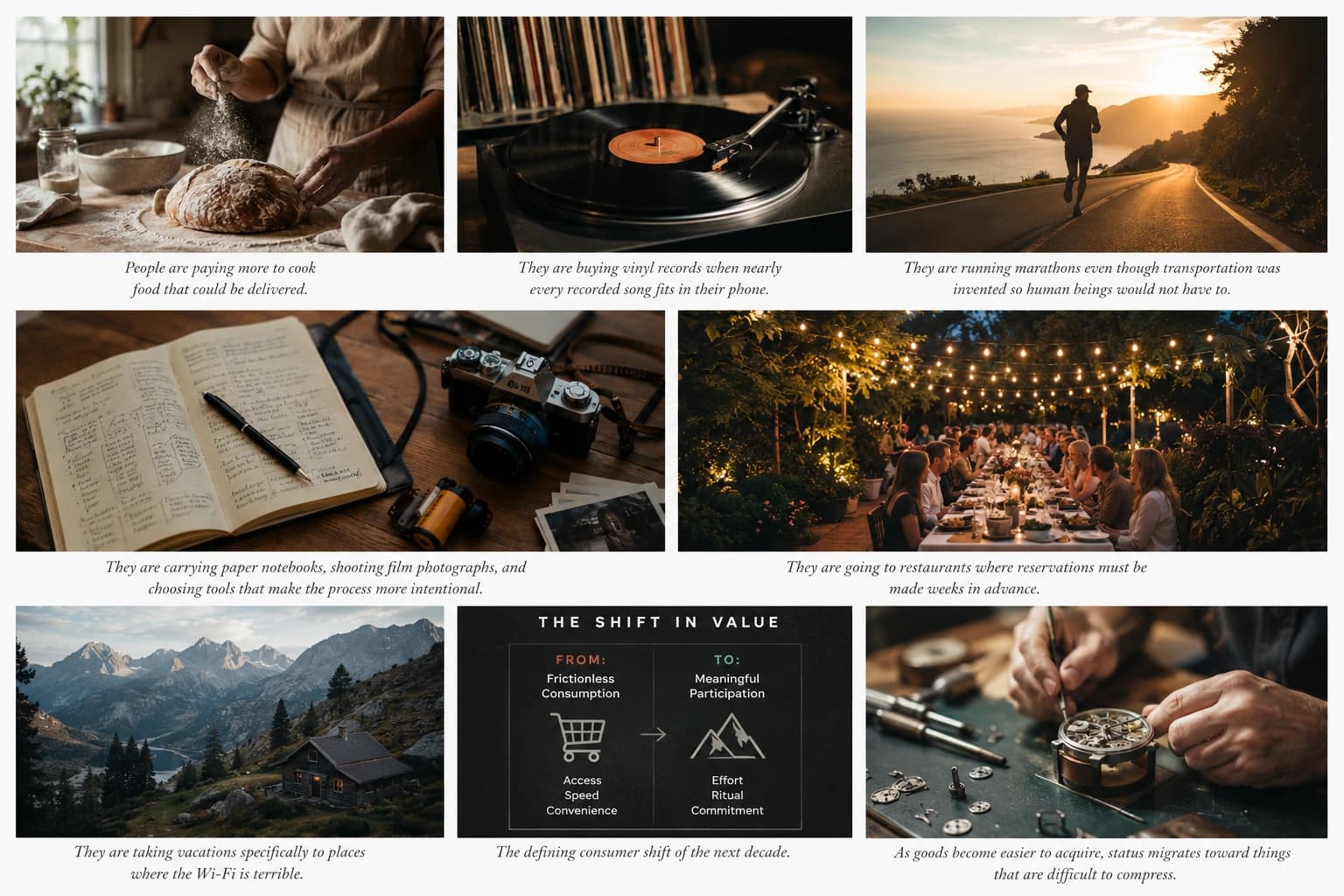
People are paying more to cook food that could be delivered.
They are buying vinyl records when nearly every recorded song in history fits inside their phone.
They are running marathons even though transportation was invented specifically so human beings would not have to travel 26 miles on foot.
They are carrying paper notebooks, shooting film photographs, baking sourdough, growing vegetables, joining book clubs, purchasing mechanical watches, going to restaurants where reservations must be made weeks in advance, and taking vacations specifically to places where the Wi-Fi is terrible.
At first glance, these behaviors look nostalgic.
They are not.
They are economic signals.
They suggest that one of the defining consumer shifts of the next decade will be a move from frictionless consumption toward meaningful participation.
And businesses that understand the difference will have an enormous advantage.
Convenience Has a Hidden Cost
Convenience is one of those rare product attributes that almost everyone claims to want.
Ask consumers whether they prefer a process with five steps or one step and the answer is obvious.
But revealed preference is more complicated.
There is a category of experiences where removing too much effort reduces the value of the experience itself.
Consider food.
If calories were the only objective, restaurants would barely make sense. A nutritionally optimized meal replacement would be cheaper, faster, and more predictable.
Yet humans routinely spend hours eating meals that could technically be consumed in minutes.
That is because the purpose of dinner is not merely to transfer nutrients into the bloodstream.
It is conversation.
Anticipation.
Atmosphere.
Memory.
Identity.
The same principle applies elsewhere.
A handwritten letter is objectively less efficient than a text message and, precisely because of that inefficiency, can communicate more care.
A handmade table may contain no functional advantage over a mass-produced one, yet the visible labor embedded in it becomes part of its value.
A difficult hike creates a better story than taking an elevator to the same altitude.
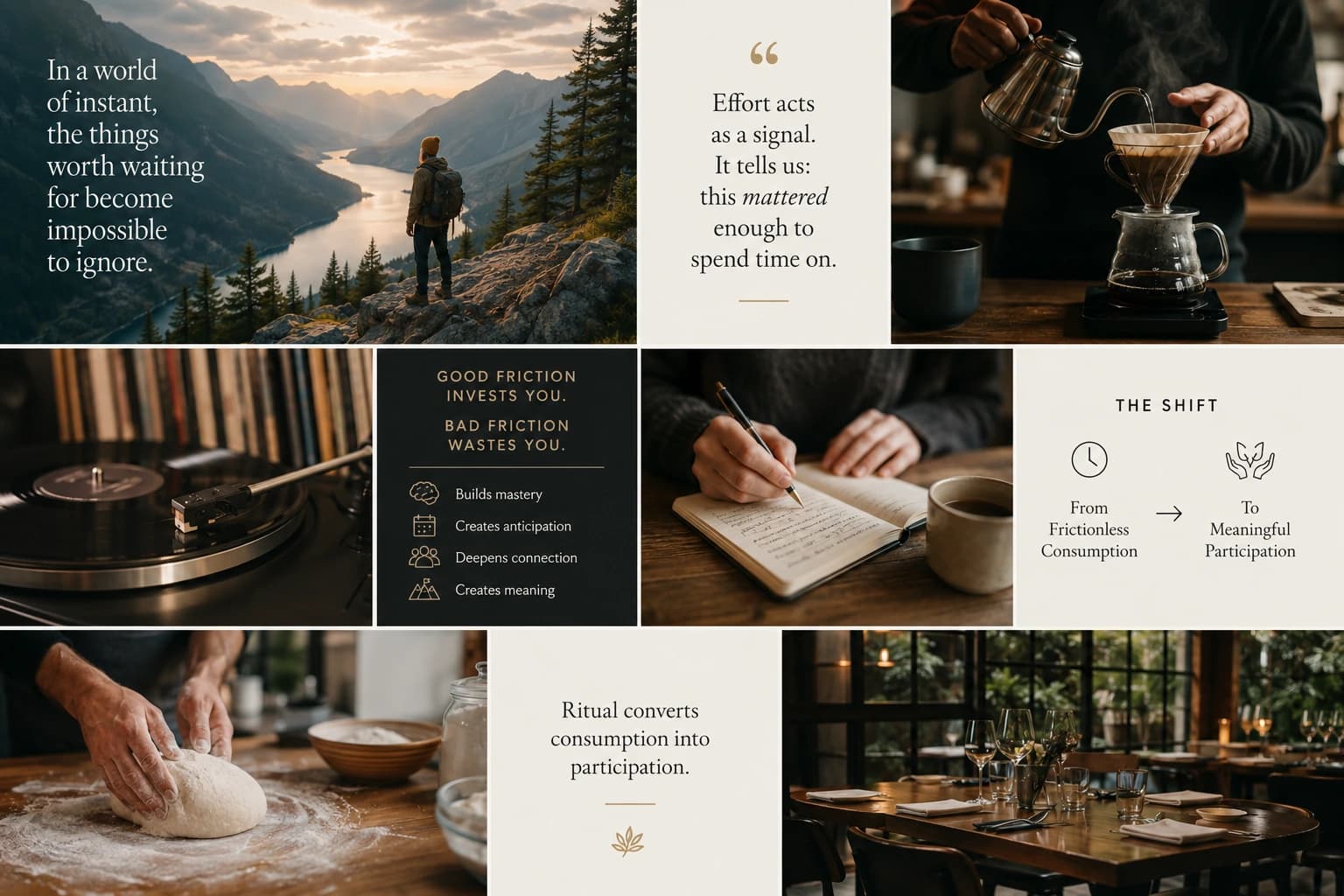
Effort acts as a signal.
It tells us: this mattered enough to spend time on.
When technology eliminates effort indiscriminately, it occasionally eliminates the meaning the effort was carrying.
This is the paradox at the center of the convenience economy:
The better we become at removing friction, the more valuable certain forms of friction become.
Abundance Changed the Problem
For most of history, consumers suffered from scarcity.
Not enough information. Not enough products. Not enough entertainment. Not enough choice.
Digital technology solved that problem so aggressively that many consumers now face the opposite one.
A person opening Netflix does not lack entertainment.
They lack a reason to choose one thing rather than another.
A Spotify user does not lack music.
They lack attention.
A shopper browsing an online marketplace does not lack options.
They lack confidence.
The modern consumer increasingly lives inside systems optimized for infinite availability.
Infinite scroll.
Infinite catalogs.
Infinite recommendations.
Infinite content.
Infinite notifications.
But human attention did not become infinite alongside them.
So the constraint shifted.
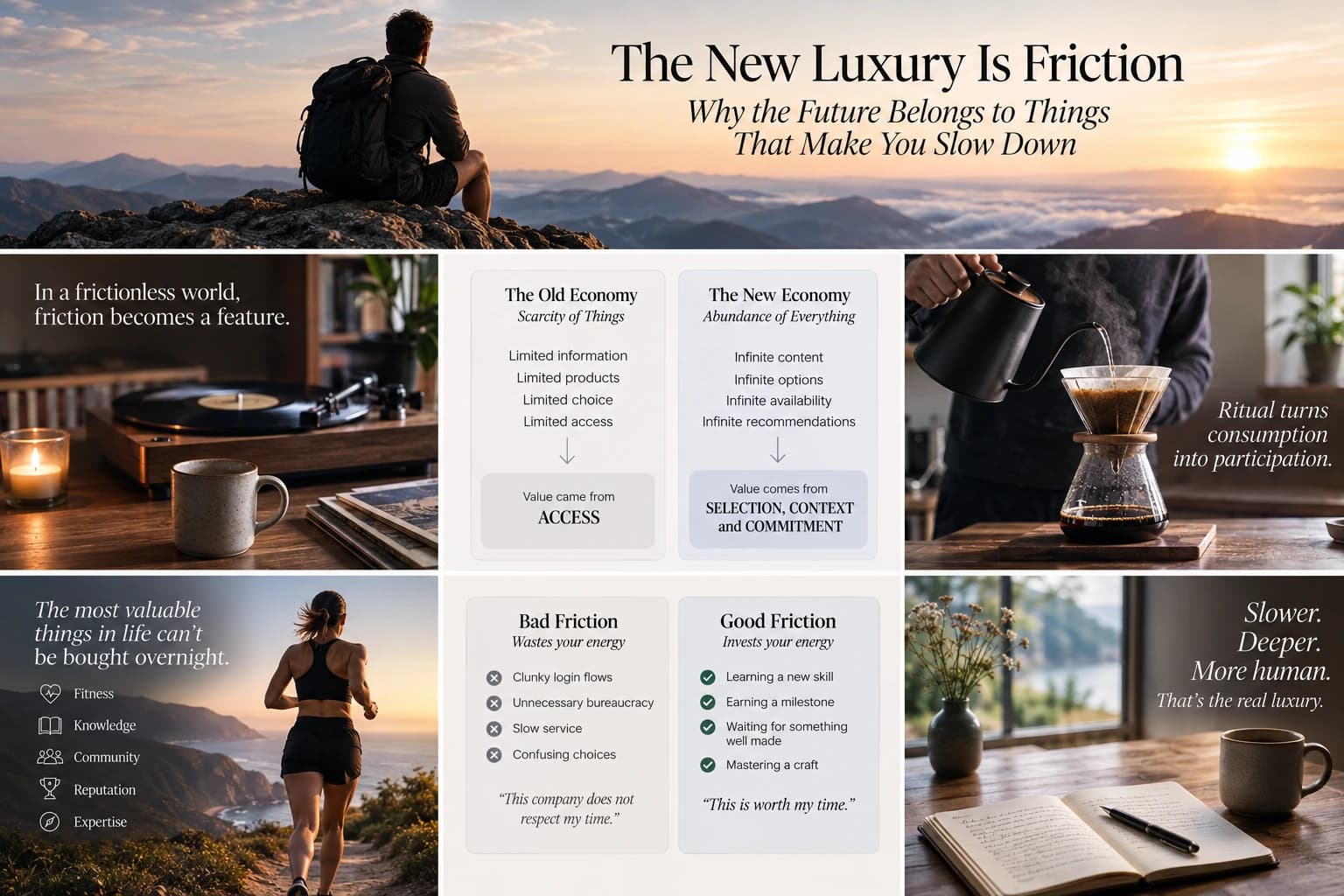
When supply was scarce, value came from access.
When supply became abundant, value moved toward selection, context, and commitment.
This is why curation suddenly matters again.
A bookstore containing 2,000 carefully selected titles can feel more valuable than an online catalog containing 20 million.
A restaurant with six items may inspire more confidence than one with 140.
A newsletter written by one thoughtful expert can be more useful than an algorithmic feed aggregating thousands of sources.
Constraint reduces cognitive load.
More importantly, it creates a point of view.
And point of view is becoming a premium product.
The Rise of Earned Experiences
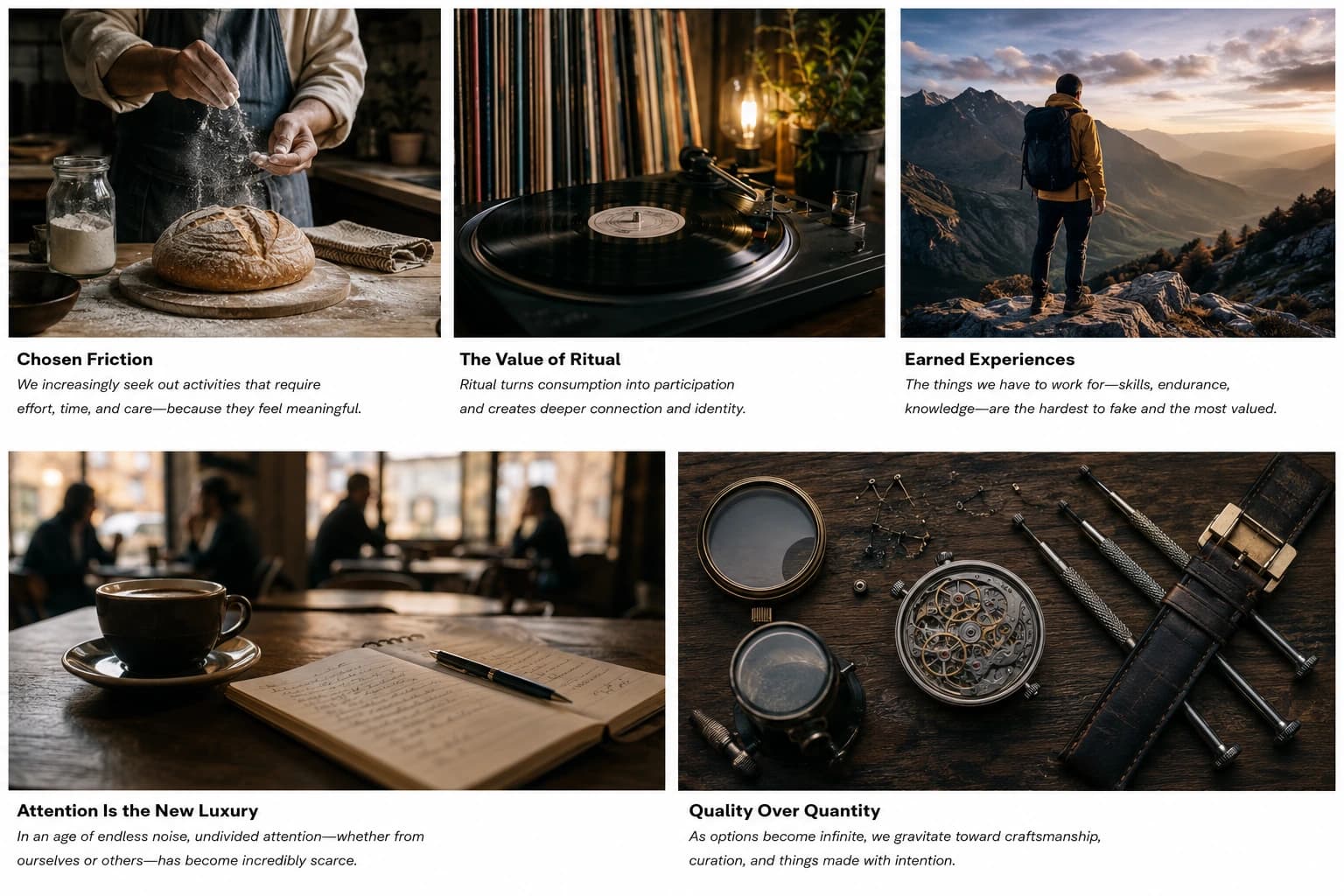
There is another reason friction is gaining value: people increasingly want experiences that cannot simply be purchased.
Luxury used to be primarily about ownership.
The rare car.
The expensive watch.
The large house.
The designer bag.
Those things still matter, of course, but material abundance has made many traditional status signals easier to imitate.
Financing can make an expensive car temporarily accessible.
Counterfeits can reproduce the appearance of a luxury product.
Social media can manufacture the visual impression of a lifestyle for a few hours.
But certain signals remain stubbornly difficult to fake.
You cannot buy the body of someone who has trained consistently for five years.
You cannot instantly purchase fluency in Japanese.
You cannot acquire a deep understanding of jazz overnight.
You cannot order twenty years of friendship for next-day delivery.
These are earned assets.
They are valuable partly because they require time, and time is one resource wealthy people cannot manufacture more of.
This creates an interesting inversion.
As goods become easier to acquire, status migrates toward things that are difficult to compress.
Fitness.
Taste.
Knowledge.
Craft.
Community.
Reputation.
Expertise.
These forms of capital accumulate slowly.
Their friction is what protects their value.
A marathon medal means something because someone had to run the marathon.
If you could buy the medal at the finish line without running, the object would remain identical while almost all of its meaning disappeared.
The value was never in the medal.
It was in the difficulty.
Why Ritual Keeps Surviving Technology
Every generation invents technologies that should theoretically destroy ritual.
Yet ritual persists.
Coffee is a good example.
Caffeine can be delivered cheaply, efficiently, and predictably.
And yet people grind beans manually, measure water temperatures, buy expensive kettles, weigh coffee to the gram, and spend ten minutes preparing a drink that could be produced by pressing a button.
From a purely functional perspective, this is irrational.
From a psychological perspective, it makes perfect sense.
Ritual converts consumption into participation.
The difference is subtle but important.
When you press a button and receive something, you are a customer.
When you grind, pour, measure, adjust, and learn, you become a practitioner.
Practitioners form stronger identities than customers.
They join communities.
They develop vocabulary.
They notice details.
They teach other people.
They spend money not simply on outcomes but on tools, knowledge, and improvement.
This is why some of the strongest brands in the world do not merely sell products.
They sell practices.
Cycling brands do not sell bicycles; they sell the identity of being a cyclist.
Camera companies do not merely sell sensors and lenses; they sell a way of seeing.
High-end cookware does not merely sell stainless steel; it sells participation in the craft of cooking.
Once customers begin to identify with the practice surrounding a product, price sensitivity often declines.
The purchase is no longer merely transactional.
It becomes autobiographical.
The Premiumization of Human Attention
There is another form of friction becoming increasingly expensive: access to another human being.
Consider the direction many industries are moving.
Software gives instant answers.
AI produces instant drafts.
Algorithms generate recommendations.
Self-checkout replaces cashiers.
Apps replace travel agents.
Chatbots replace basic customer service.
As automation absorbs routine interactions, genuinely attentive human service becomes rarer.
And rarity creates pricing power.
A mass-market hotel may encourage guests to check in through an app.
A luxury hotel remembers your name.
A cheap financial platform gives you dashboards.
A premium advisory service gives you a person who understands your circumstances.
Mass education distributes information.
Elite education often sells access—to professors, mentors, networks, peers, and individualized feedback.
This pattern will accelerate.
Paradoxically, the more capable automation becomes, the more meaningful undivided human attention may feel.
A doctor who listens for forty minutes.
A teacher who remembers how you think.
A shopkeeper who knows your taste.
A chef who explains where the ingredients came from.
A craftsman who makes something specifically for you.
These interactions are inefficient.
That inefficiency is exactly why they are difficult to scale.
And what cannot be scaled cheaply often becomes premium.
The Business Mistake: Optimizing Everything
Modern businesses are obsessed with conversion funnels.
Every additional click is treated as leakage.
Every delay is a threat.
Every moment of hesitation must be eliminated.
This makes sense when the objective is purely transactional.
But not every business should optimize exclusively for transactions.
Sometimes the extra step creates commitment.
IKEA famously requires customers to assemble much of its furniture themselves. From the perspective of convenience, this seems like a defect.
Psychologists have studied a related phenomenon sometimes called the “IKEA effect”: people can assign greater value to things they helped create.
Participation generates attachment.
The broader principle is far more important than furniture.
When customers contribute effort, the experience can become psychologically theirs.
This is why customization works.
Why games have levels.
Why loyalty programs have status tiers.
Why fitness apps track streaks.
Why language-learning apps celebrate progress.
Why professional communities create certifications.
These mechanisms introduce friction, but they transform passive consumption into achievement.
The question for businesses is therefore not:
How do we remove all friction?
It is:
Which friction prevents value, and which friction creates value?
That distinction may become one of the most important design questions of the next decade.
Bad Friction vs. Good Friction
Bad friction wastes the customer's energy.
Good friction invests it.
Bad friction is resetting a password because the authentication system is poorly designed.
Good friction is completing a difficult lesson and realizing you understand something you did not understand yesterday.
Bad friction is waiting forty minutes because a restaurant is understaffed.
Good friction is waiting three months for a handcrafted object made specifically for you.
Bad friction creates resentment.
Good friction creates anticipation.
The emotional difference is enormous.
One says:
“This company does not respect my time.”
The other says:
“This is worth my time.”
Premium businesses increasingly operate in the second category.
They do not necessarily make everything faster.
They make certain things worth slowing down for.
The Strange Future of Luxury
For decades, futurists imagined that wealth would look increasingly effortless.
Machines would cook.
Cars would drive themselves.
Algorithms would organize our schedules.
Artificial intelligence would answer questions instantly.
Homes would anticipate our needs.
Much of that future is arriving.
But when basic convenience becomes universally available, convenience itself stops functioning as a strong status signal.
The luxury version of the future may therefore look surprisingly analog.
Not because wealthy consumers will reject technology.
They will use enormous amounts of it.
But they may increasingly use technology to protect something technology also threatens to destroy:
their attention.
Luxury could mean having a phone that does not interrupt you.
A vacation where nobody can reach you.
A membership that limits who gets in.
A restaurant that refuses delivery.
A school where children spend fewer hours staring at screens.
A house filled with objects made by identifiable human beings.
A weekend where nothing is optimized.
In a world engineered to eliminate waiting, choosing to wait can become a statement.
In a world engineered for constant stimulation, boredom can become restorative.
In a world where everything is available instantly, anticipation becomes rare.
And rarity, eventually, becomes luxury.
The Most Valuable Products May Give Us Something Back
The first generation of the internet competed to capture attention.
The next generation of premium products may compete to return it.
The winners will not necessarily be the companies that offer the most.
They may be the companies confident enough to offer less.
Fewer notifications.
Fewer choices.
Fewer features.
Fewer interruptions.
More ritual.
More mastery.
More participation.
More human contact.
More meaning.
For twenty years, product design followed a simple commandment:
Remove friction.
The next era requires a more sophisticated one:
Remove the friction that wastes people's lives. Preserve the friction that gives life texture.
Because once everything becomes effortless, effort itself begins to mean something.
And when everything becomes instant, the things worth waiting for become impossible to ignore.


Loading the conversation…