
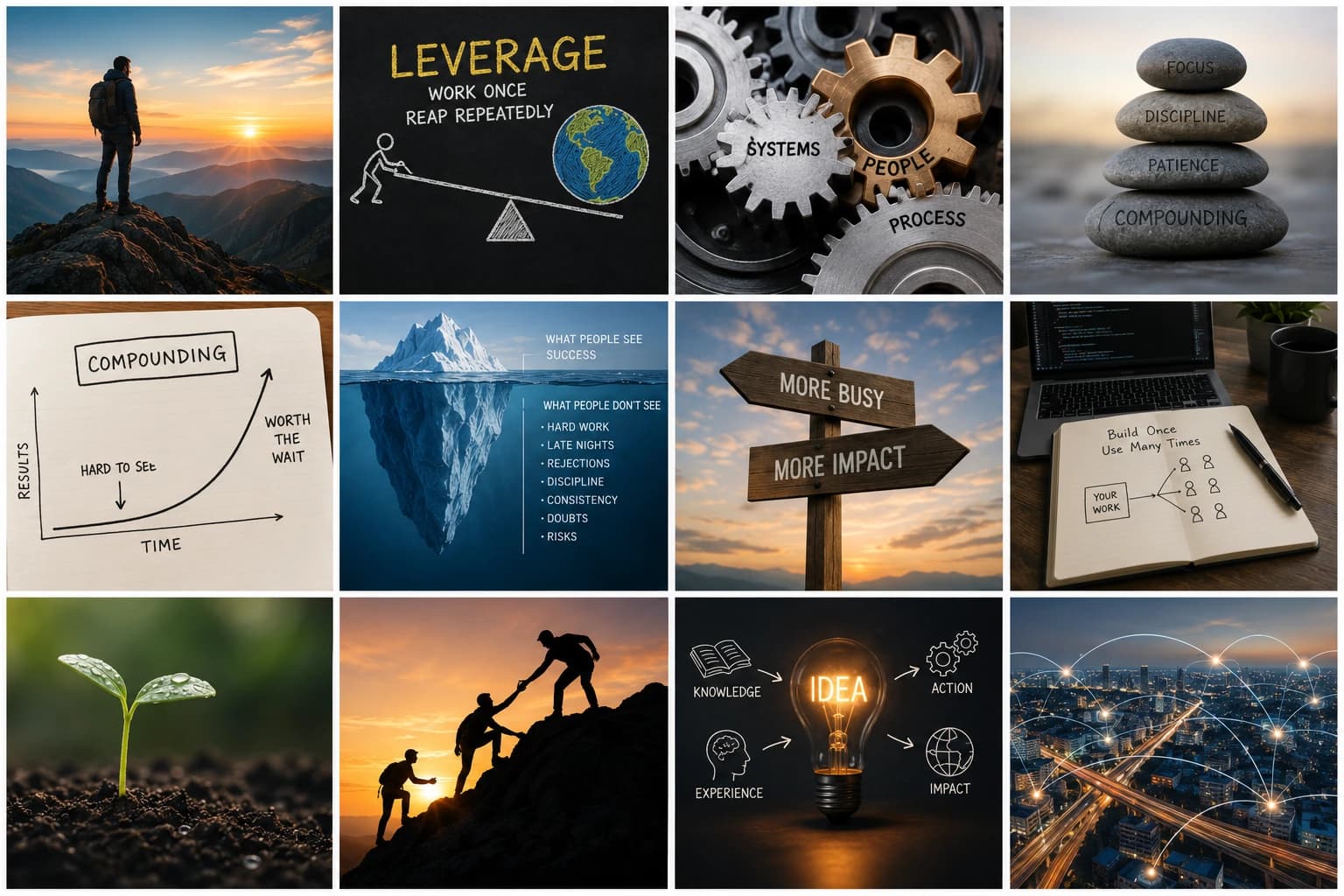
Why the most valuable skill in the next decade may be learning to recognize forces that multiply your time, judgment, and reputation
Most people think wealth is built by working harder, knowing more, or being unusually talented.
Those things help. But they are not the real dividing line.
The people who appear to move impossibly fast—founders who build companies with tiny teams, writers who command enormous audiences, investors whose decisions compound for decades, employees who become disproportionately valuable—usually have something else working in their favor.
They have leverage.
Not necessarily financial leverage. Not the reckless kind involving borrowed money and fragile balance sheets.
The more interesting form is invisible.
It is the ability to make one good decision and have that decision continue producing value after you have stopped actively working on it.
A factory is leverage. Software is leverage. Capital is leverage. An audience is leverage. A reputation is leverage. A well-designed system is leverage. A piece of writing that changes thousands of minds is leverage.
And increasingly, artificial intelligence is leverage.
The economic story of the next decade will not simply be about AI replacing particular jobs. It will be about a widening gap between people who understand how to compound their effort and people who still sell their time one hour at a time.
That distinction matters more than it initially appears.
The Old Economic Bargain
For most of modern history, productivity was constrained by a simple fact: human effort did not scale very well.
A carpenter could build only so many tables. A lawyer could review only so many contracts. A teacher could teach only so many students. A manager could supervise only so many employees.
Income was therefore closely connected to time.
More work generally meant more output.
The industrial revolution weakened that relationship.
A worker operating machinery could suddenly produce far more than a worker using only hand tools. Machines multiplied physical effort.
The internet weakened it further.
A programmer could write software once and distribute it to millions of people. A musician could record a song once and have it played billions of times. A writer could publish an article that continued attracting readers years later.
Digital technology began multiplying intellectual effort.
AI extends that transition into a new territory.
It begins multiplying cognitive execution.
Research, synthesis, drafting, coding, analysis, design iteration, translation, documentation and countless other activities that once consumed significant human attention can increasingly be accelerated.
The obvious conclusion is that people will simply become more productive.
The more important conclusion is that productivity will become increasingly unequal.
Because access to leverage does not automatically produce skill at using it.
Give two people the same powerful tool and you rarely get the same outcome.
One person uses it to complete yesterday's tasks faster.
The other redesigns the entire workflow.
That difference is enormous.
The Productivity Trap
Whenever a technology makes work easier, organizations tend to make a predictable mistake.
They use the saved time to produce more of the same thing.
Email made communication cheap, so companies created more email.
Presentation software made slides easy to produce, so companies created more slides.
Analytics tools made measurement easier, so organizations created more dashboards.
AI can easily follow the same pattern.
A marketing department that previously published four mediocre articles a month may soon publish forty mediocre articles a month.
A sales team that sent 500 generic emails may send 50,000 slightly personalized ones.
Companies may automate the production of reports nobody needed in the first place.
This is not leverage.
It is industrialized busywork.
True leverage changes the economics of an activity.
The important question is not:
How can this tool help me do my existing work faster?
It is:
What becomes possible when the cost of this kind of work approaches zero?
Those questions produce radically different answers.
Imagine research that once required three days now requires thirty minutes.
The unimaginative response is to finish the research earlier.
The interesting response is to ask whether you can now investigate ten competing hypotheses instead of one.
Imagine prototype development becomes ten times faster.
The unimaginative response is to build the planned prototype more quickly.
The interesting response is to test ten different product concepts before committing to one.
When execution becomes cheap, the scarce resource moves elsewhere.
Usually toward judgment.

Judgment Is Becoming More Valuable, Not Less
For years, knowledge workers were rewarded partly because certain tasks were difficult.
Writing a competent report was difficult.
Creating a functioning software prototype was difficult.
Producing a polished presentation was difficult.
Analyzing a large body of information was difficult.
Difficulty created scarcity, and scarcity supported wages.
But whenever technology reduces the cost of execution, value migrates upstream.
Consider photography.
When taking technically competent photographs required expensive equipment and specialized knowledge, technical competence itself was valuable.
Smartphones demolished that scarcity.
Billions of people can now take technically acceptable photographs.
So what became valuable?
Taste.
Composition.
Timing.
Storytelling.
Access.
Identity.
The camera became easier to operate, but becoming a great photographer did not.
Something similar is happening across knowledge work.
If everyone can generate acceptable prose, prose itself becomes less scarce.
Knowing what is worth saying becomes more valuable.
If everyone can produce software, code becomes less scarce.
Knowing what should be built becomes more valuable.
If everyone can create analysis, analysis becomes less scarce.
Knowing which questions deserve analysis becomes more valuable.
AI does not eliminate expertise.
It exposes shallow expertise.
There Are Four Kinds of Leverage
One useful way to think about modern careers is to ask which forms of leverage you are accumulating.
1. Code
Software allows work to reproduce itself.
A developer can spend months creating a product that serves users continuously afterward.
The extraordinary feature of software is that the marginal cost of another user can be close to zero.
One person can therefore create something used by millions.
AI is making software creation accessible to increasingly large numbers of people.
That does not mean everyone becomes a world-class engineer.
It means the distance between an idea and a functioning tool is shrinking.
That shift favors people who notice valuable problems.
2. Media
Writing, video, podcasts and social platforms create another peculiar form of leverage.
A conversation disappears after it happens.
A piece of media can keep working.
A thoughtful article written on Tuesday might generate customers, job opportunities, partnerships or reputation for years.
This is why publishing has become such a powerful career strategy.
A person who consistently explains useful ideas develops what might be called a public proof of thought.
Your ideas become searchable.
Your judgment becomes observable.
Your expertise stops being confined to people who happen to work beside you.
The internet turns reputation into an asset that can compound.
3. Capital
Capital is the oldest scalable leverage.
Money can own productive assets.
A business generates profits. Shares participate in companies. Property generates rent. Intellectual property generates royalties.
But capital has a deeper characteristic that makes it powerful:
It can continue working while you are doing something else.
This creates a profound economic difference between income and ownership.
Income rewards current activity.
Ownership rewards participation in future value.
People frequently spend decades optimizing salary while underestimating the importance of accumulating assets.
The distinction is subtle in the short term and enormous over long periods.
4. Systems
The least glamorous form of leverage may be the most accessible.
Systems turn repeated decisions into processes.
A checklist is leverage.
A reusable template is leverage.
A hiring process is leverage.
A database of institutional knowledge is leverage.
A documented workflow is leverage.
A strong organizational culture is leverage.
Anything that allows future work to benefit from past thinking creates leverage.
This is why exceptionally effective people often appear unusually organized.
They are not simply completing tasks.
They are constantly asking:
Will I ever need to solve this problem again?
If the answer is yes, they try to solve the category rather than the instance.
The Career Mistake Nobody Notices
Most people manage careers as a sequence of jobs.
A better model is to manage a career as a portfolio of compounding assets.
After five years of work, what remains?
If the only answer is salary earned and tasks completed, very little of your previous effort continues helping you.
But imagine five years produces:
- a rare technical skill,
- a strong professional network,
- a public body of writing,
- ownership in valuable assets,
- reusable software,
- a trusted reputation,
- specialized industry knowledge,
- and hundreds of documented systems.
Now your past is working for your future.
This is the crucial difference between experience and accumulation.
Experience is what happened to you.
Accumulation is what remains useful afterward.
A twenty-year career does not automatically create twenty years of leverage.
Some people effectively repeat the same year twenty times.
Others build layers.

Reputation Might Be the Highest-Return Asset
Reputation has strange economics.
It takes years to build but can accelerate almost everything afterward.
People respond faster.
Opportunities arrive without applications.
Customers trust more quickly.
Negotiations become easier.
Talented people want to work with you.
Your ideas receive attention before they are fully evaluated.
This is not always fair.
But it is economically real.
Reputation reduces what economists might call transaction costs.
People spend less time wondering whether you are competent, trustworthy or serious.
The decision has partially been made in advance.
That means reputation functions like stored credibility.
And like most compounding assets, its early returns appear disappointing.
Writing one excellent article rarely transforms a career.
Helping one person rarely creates a powerful network.
Delivering one exceptional project rarely creates industry-wide trust.
But repeated evidence accumulates.
Then something strange happens.
The returns stop looking linear.
People begin discovering you through other people.
Your work generates opportunities you did not pursue.
Your reputation starts doing introductions on your behalf.
This is leverage in its purest form: previous behavior creating future opportunities without equivalent additional effort.
The Dangerous Side of Leverage
Leverage multiplies outcomes.
It does not guarantee good ones.
A person with poor judgment and no leverage can cause limited damage.
A person with poor judgment and enormous leverage can destroy a company.
Social media gives foolish ideas distribution.
Capital allows bad decisions to become expensive.
Software allows mistakes to reach millions of users.
AI allows mediocre thinking to be produced at astonishing speed.
This is why technological progress often increases the value of wisdom.
The more powerful the tools, the more consequential the person operating them becomes.
We tend to imagine advanced technology reducing human importance.
In practice, it often concentrates importance around fewer decisions.
Consider a company where one executive can direct automated systems serving millions of customers.
The executive may perform less direct work than previous generations.
But the consequences of each decision become larger.
Execution becomes abundant.
Direction becomes scarce.
The New Definition of Hard Work
None of this means effort stops mattering.
It means the highest-return form of effort changes.
Industrial-era hard work often looked like endurance.
Long hours.
Physical repetition.
Administrative persistence.
Knowledge-economy hard work increasingly looks like concentration.
Thinking carefully when distraction is easier.
Learning something difficult before it is fashionable.
Publishing useful ideas before anyone is paying attention.
Building systems before the workload demands them.
Maintaining standards when tools make mediocrity effortless.
Perhaps most importantly, it means spending time on activities whose rewards are delayed.
Compounding is psychologically difficult because early progress is almost invisible.
The first hundred followers feel insignificant.
The first thousand dollars invested feels insignificant.
The first reusable workflow feels insignificant.
The first year learning a difficult skill feels painfully slow.
Then accumulation changes the geometry.
Eventually the question is no longer how much effort you can produce.
It becomes how much accumulated leverage each unit of effort can activate.
A Useful Question to Ask Every Friday
At the end of each week, ask yourself:
What did I create this week that can continue producing value next week?
Not what did I finish.
Not how busy was I.
Not how many meetings did I attend.
What remains?
Maybe it is a relationship strengthened.
A document future employees can use.
A piece of software.
A piece of writing.
A better process.
A new skill.
An investment.
A dataset.
A reputation for solving a particular class of problems.
Some weeks the answer will be uncomfortable.
You may realize you were extremely productive but accumulated almost nothing.
That realization is useful.
Because the deepest economic divide of the coming decade may not be between people who use AI and people who do not.
It may be between people who use technology to produce more activity and people who use it to build more leverage.
Activity makes you tired.
Leverage makes your previous work participate in your future.
And once you see the difference, it becomes difficult to look at work the same way again.



Loading the conversation…