
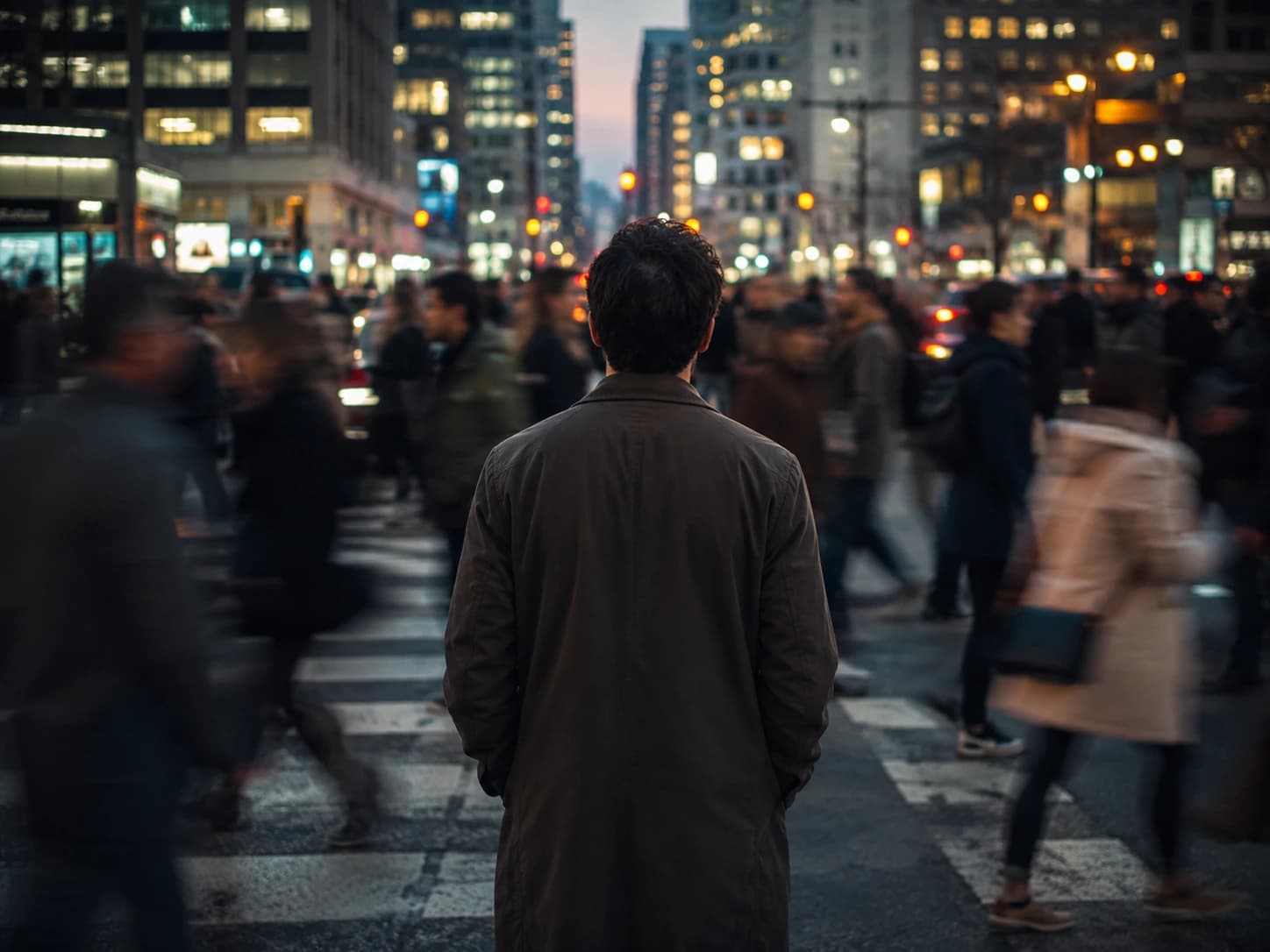
There is a strange contradiction at the center of modern life.
We have never owned more machines designed to save time. Groceries arrive at our doors. Messages cross continents instantly. Software writes summaries, books appointments, remembers passwords, recommends restaurants, edits photographs, and answers questions that once required an afternoon in a library.
And yet almost nobody feels as though they have an abundance of time.
Ask people what they would like more of and, after money, the answer is often some version of the same thing: time to think, time to rest, time to exercise, time to see friends, time to do work properly, time to do nothing at all.
This is usually treated as a productivity problem. We assume our calendars need better optimization, our mornings need stricter routines, or our phones need another set of notification controls.
But the deeper problem is economic.
When technology reduces the cost of doing something, we tend not to bank the savings. We consume more of the thing.
The result is one of the defining paradoxes of the modern economy: efficiency has made individual tasks cheaper while simultaneously expanding the number of tasks we believe we should be doing.
We did not use technology to empty our lives.
We used it to increase their carrying capacity.
And now we are living at capacity.
I. The Forgotten Law of Convenience
Imagine that sending a business letter once required 30 minutes.
You had to write it, print it, find an envelope, address it, attach postage, and place it in the mail. Because communication was expensive, people communicated selectively.
Then email reduced the marginal cost of sending a message to almost zero.
What happened?
We did not simply send the same number of letters faster.
We sent vastly more messages.
The same pattern appears everywhere.
When photographs were expensive, families took a few dozen photographs on vacation. When photographs became free, people took hundreds.
When television required being home at a specific time, people watched a limited schedule. When entertainment became available on demand, entire seasons became an evening's possibility.
When shopping required driving to a store, browsing was constrained by geography and opening hours. When shopping became a thumb movement, consumption became continuous.
Economists have a useful concept for this phenomenon: when efficiency lowers the cost of an activity, demand for that activity can rise enough to consume part—or occasionally all—of the efficiency gain.
The principle is often discussed in relation to energy use. But it deserves far more attention as a theory of human time.
Call it the convenience rebound.
A technology saves us ten minutes.
Instead of receiving ten minutes of leisure, we discover twelve minutes of new expectations.
II. Efficiency Creates Expectations
The hidden cost of technological progress is rarely the technology itself.
It is the expectations that form around it.
Consider workplace communication.
A century ago, receiving a written response from another city within a week might have been considered efficient.
Then came telephones.
Then fax machines.
Then email.
Then smartphones.
Then workplace chat.
At every stage, the technical delay decreased—and the socially acceptable delay decreased with it.
Today, a person can possess extraordinarily powerful communication technology while simultaneously experiencing greater anxiety about communication than someone living before the internet.
The contradiction disappears once you understand that technology does not merely change what is possible.
It changes what other people expect from you.
If a message can technically be answered immediately, silence begins to acquire meaning.
If a document can technically be revised instantly, revisions multiply.
If employees can technically be reached anywhere, work begins escaping the physical boundaries of the workplace.
If consumers can technically receive products tomorrow, waiting three days begins to feel slow.
Convenience gradually moves from being a luxury to being infrastructure, and then from infrastructure to expectation.
Eventually, yesterday's miracle becomes today's minimum standard.
This process has an important consequence.
The benefits of technology often arrive privately, while the expectations it generates become collective.
One employee cannot easily decide that email should operate at 1998 speed.
One company cannot casually announce that customer inquiries will be answered according to 1970s standards.
One teenager cannot single-handedly redefine the response time norms of their entire social group.
Once convenience becomes normalized, opting out can feel less like simplicity and more like failure.

III. The Expansion of the Possible
There is another reason modern people feel overloaded.
Our problem is no longer primarily scarcity of opportunity.
It is abundance.
For most of human history, geography brutally limited possibility.
You ate at restaurants near you.
You married people you could plausibly meet.
You worked for organizations operating within reachable distance.
You listened to the music you could obtain.
You read books stocked by local booksellers and libraries.
Your world could be narrow, but it was at least comprehensible.
The internet destroyed many of those boundaries.
This was, overwhelmingly, an extraordinary achievement.
But abundance creates a psychological problem that scarcity does not.
Every choice now competes against an enormous universe of alternatives.
You are not simply choosing a restaurant. You are choosing among every restaurant within delivery distance while simultaneously comparing ratings, photographs, prices, cuisines, dietary options, discounts, and estimated arrival times.
You are not simply watching television. You are standing before a nearly bottomless archive of human entertainment.
You are not simply buying running shoes. You can spend two evenings researching heel drops, foam compounds, durability tests, Reddit reviews, professional reviews, YouTube comparisons, and thousands of customer ratings.
Economists traditionally describe choice as empowering.
Psychologically, however, unlimited choice comes with an invisible invoice.
Every option creates another possible world in which you might have chosen better.
And because digital systems preserve alternatives indefinitely, decisions that once ended can remain psychologically open.
There is always another article you could read.
Another course you could take.
Another city you could visit.
Another career you could pursue.
Another person you could meet.
Another investment you could research.
Another version of yourself you could theoretically become.
The modern person is therefore haunted not merely by obligations, but by unlived possibilities.
That is a historically unusual form of pressure.
IV. The Industrialization of Self-Improvement
Perhaps nowhere is this pressure more visible than in the modern idea of self-improvement.
The contemporary person is encouraged to treat nearly every domain of life as an optimization problem.
Sleep can be optimized.
Nutrition can be optimized.
Exercise can be optimized.
Finances can be optimized.
Relationships can be optimized.
Careers can be optimized.
Morning routines can be optimized.
Even relaxation can be optimized through carefully designed recovery protocols.
There is nothing inherently wrong with improving any of these things.
The problem appears when optimization becomes a moral atmosphere.
A healthy activity quietly transforms into an obligation.
Reading is no longer reading; it becomes a target of 30 books per year.
Walking becomes 10,000 steps.
Sleep becomes a score.
Friendship becomes networking.
Writing becomes content.
Hobbies become side hustles.
Meals become macronutrient calculations.
Vacations become itineraries.
The self becomes a project under permanent renovation.
This is one reason high-performing people can feel particularly dissatisfied. Their competence expands the number of things they are capable of managing, and that capacity attracts further commitments.
Efficiency becomes self-defeating.
The better you become at clearing your inbox, the more reliably people email you.
The faster you complete work, the more work you become trusted with.
The more organized your life becomes, the easier it is to squeeze another obligation into it.
Competence creates capacity.
Capacity attracts demand.
Demand eliminates slack.
And slack—the apparently inefficient space between obligations—is where much of human life actually happens.
V. Why Free Time Disappears
Suppose technology genuinely gives someone an extra hour every day.
What happens to it?
Occasionally, the person rests.
More often, the hour is absorbed.
A longer commute becomes acceptable.
A second project becomes feasible.
Another streaming episode becomes possible.
Another meeting fits.
Another hobby enters the schedule.
Another group chat emerges.
Another errand gets completed.
The hour does not remain an hour.
It becomes available territory.
This resembles what happens to highways.
Cities widen congested roads believing that additional capacity will reduce traffic. Initially, it often does.
Then people change behavior.
Some take trips they previously avoided. Others move farther away. Developers build around the new infrastructure. Driving becomes more attractive.
Before long, traffic returns.
Human schedules behave similarly.
Create unused capacity and life tends to discover uses for it.
This is why time-management systems can produce such disappointing emotional returns. They may successfully increase output while leaving subjective busyness unchanged.
A person becomes 20 percent more efficient and unconsciously accepts 20 percent more commitments.
The calendar remains full.
The stress remains.
Only throughput has increased.

VI. The Luxury of Inefficiency
For much of the industrial age, efficiency was treated almost unquestioningly as progress.
And in factories, logistics networks, hospitals, and infrastructure, efficiency can indeed save enormous amounts of money and human suffering.
But human lives are not factories.
Some of the most valuable experiences we have are economically inefficient.
Friendship is inefficient.
Children are inefficient.
Cooking slowly is inefficient.
Walking instead of driving is inefficient.
Reading a difficult book is inefficient.
Sitting in a café without opening a laptop is inefficient.
Having a three-hour dinner with people you love is disastrously inefficient.
These activities create relatively little measurable output for the time they consume.
That is precisely why they matter.
Efficiency asks:
How much can be extracted from this hour?
A human life eventually asks a different question:
Was the hour worth living?
The distinction sounds philosophical, but it has practical consequences.
If every empty space in life is treated as unused capacity, technological progress will never create enough leisure.
Any new efficiency will simply permit another obligation.
The only durable way to create free time is therefore not to save it.
It is to refuse to spend it.
VII. The Case for Artificial Scarcity
We often think of scarcity as something civilization should eliminate.
But voluntary scarcity can be psychologically valuable precisely because the modern world contains too little of it.
A restaurant with a five-page menu can feel strangely exhausting.
A restaurant with twelve carefully chosen dishes can feel liberating.
A wardrobe with endless clothing creates daily decisions.
A smaller wardrobe creates constraints.
A phone containing every form of entertainment ever invented makes boredom nearly impossible.
A walk without a phone restores it.
Constraints remove possibilities.
That sounds negative until you realize that possibilities have cognitive weight.
This suggests a counterintuitive principle for designing a calmer life:
Sometimes the solution to abundance is not better selection. It is fewer available choices.
Do not merely choose which notifications to answer.
Turn some off entirely.
Do not merely optimize your streaming queue.
Occasionally decide not to watch anything.
Do not merely maintain a perfectly prioritized task list.
Delete obligations that should never have become tasks.
Do not simply schedule leisure.
Create periods during which productivity is forbidden.
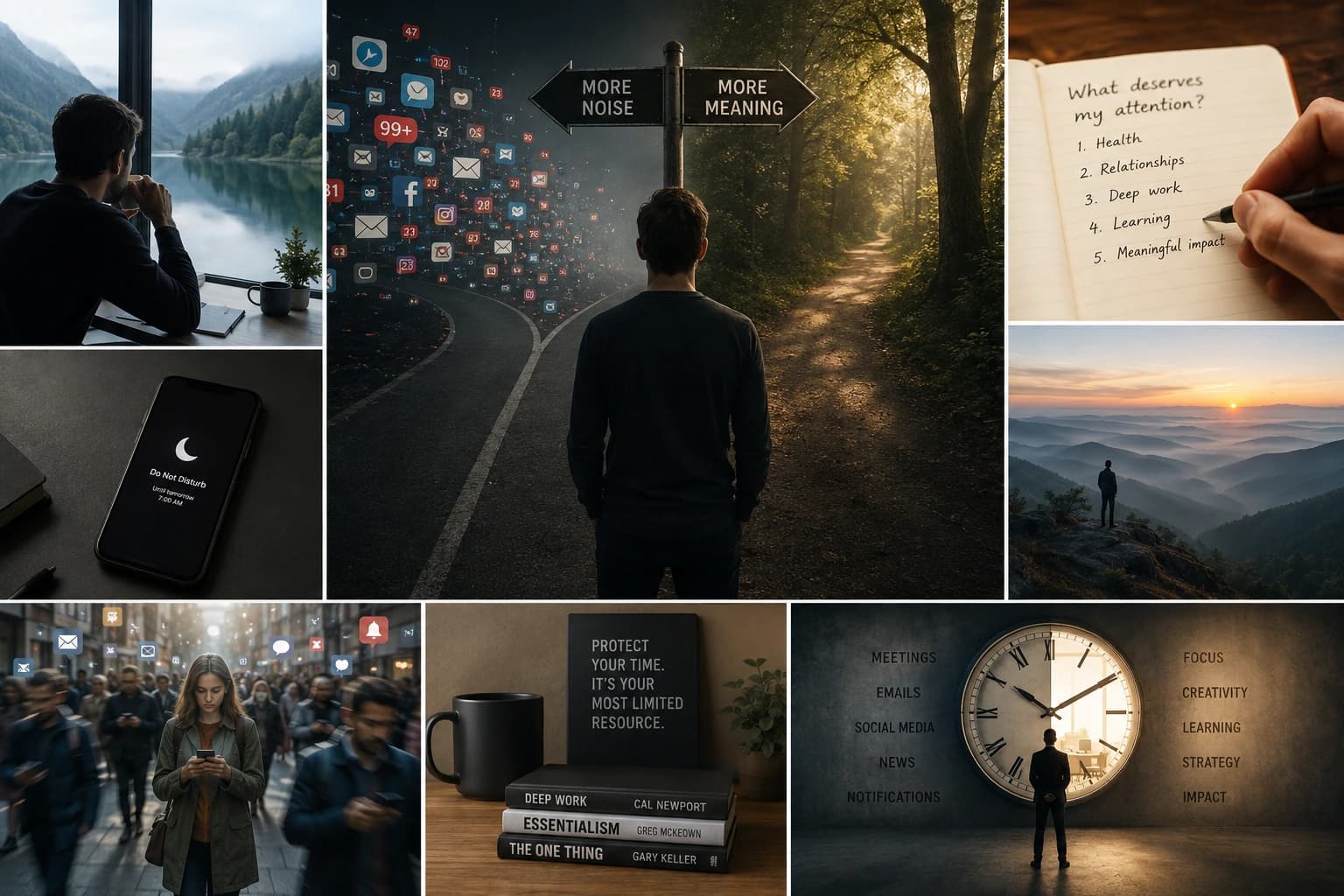
Artificial scarcity protects attention from markets that are extraordinarily skilled at consuming it.
And attention may be the resource modern life is actually running out of.

VIII. A New Definition of Wealth
The industrial definition of wealth was largely material.
More money.
More possessions.
More access.
More mobility.
Those remain important, particularly for people who do not have enough of them.
But once basic needs and financial security are reasonably satisfied, another form of wealth becomes increasingly visible.
Call it discretionary attention.
It is the ability to wake up and decide what deserves your mind.
A wealthy person in this sense can read for two hours without checking messages.
They can take an afternoon walk without feeling they are falling behind.
They can have dinner without documenting it.
They can ignore an email until tomorrow.
They can pursue something that has no obvious economic payoff.
They possess something rare: portions of life that have not already been claimed.
This may become one of the great status divisions of the twenty-first century.
Not simply between people who have expensive things and people who do not.
But between people whose attention belongs to them and people whose attention has been completely allocated by employers, platforms, clients, algorithms, notifications, and obligations.
The ultimate luxury may not be owning more.
It may be being unreachable.
IX. Technology Is Not the Villain
It is tempting to turn this argument into a familiar story about digital technology destroying civilization.
That would be too easy.
Technology has produced enormous benefits. The same smartphone that interrupts dinner can summon emergency assistance, translate languages, connect families across continents, provide navigation, manage finances, and give billions of people access to much of humanity's accumulated knowledge.
The problem is not that our tools are too powerful.
It is that human expectations expand almost effortlessly while human attention does not.
We have dramatically increased the number of things a person can do in a day without increasing the number of days a person gets.
That mismatch matters.
Technology expands possibility.
Culture converts possibility into expectation.
Individuals experience the resulting gap as inadequacy.
Perhaps the most important sentence to remember is this:
The fact that something is possible does not create an obligation to do it.
You can answer immediately.
You do not always have to.
You can consume every piece of news.
You do not need to.
You can improve every metric.
You should not.
You can fill every hour.
You probably should not.
X. The Real Purpose of Progress
There is an old fantasy embedded inside technological progress.
Machines would eventually perform so much labor that human beings would inherit enormous amounts of leisure.
The machines arrived.
The leisure did not.
Perhaps the fantasy misunderstood the problem.
Leisure was never going to be automatically delivered by efficiency because there is no natural limit to human desire, competition, ambition, or expectation.
If we want technological progress to produce better lives rather than merely denser ones, we must make a deliberate decision about where efficiency ends.
Otherwise every saved minute will be auctioned back to productivity.
Every friction removed will invite another demand.
Every faster tool will become a faster expectation.
And we will continue building extraordinarily efficient lives that somehow contain no empty afternoons.
The most radical response to the age of optimization may therefore be surprisingly simple.
Leave something unfinished.
Walk somewhere slowly.
Take the long lunch.
Read the book nobody needs you to summarize.
Protect an hour that produces nothing you can measure.
Because the purpose of saving time was never supposed to be the opportunity to do more work.
The purpose was to have some time left over.
And perhaps the great challenge of modern life is learning that time left over is not wasted time.
It is the part we were trying to save in the first place.


Loading the conversation…