
Few games have survived history with the elegance of chess.
Its equipment is almost austere: sixty-four squares, thirty-two pieces, two players, and a set of rules that can be learned in an afternoon. Yet from these modest ingredients emerges a universe of extraordinary depth. A single chessboard can contain calculation, psychology, memory, creativity, courage, deception, restraint, and beauty. It is at once a contest and a conversation—a battle conducted without noise, where every move reveals something about the mind that made it.
Chess has endured not because it is merely difficult, but because it captures something fundamental about human intelligence: the tension between what we can calculate and what we must ultimately judge.
A Game Without Chance
Unlike many games, chess offers no convenient scapegoat.
There are no dice to blame, no shuffled cards, no fortunate bounce of a ball. Both players begin with identical forces arranged symmetrically across the board. The information is visible to everyone. Nothing is hidden except intention.
That purity gives chess its peculiar severity.
Every move changes the position permanently. A pawn pushed forward cannot retreat. A careless king move may destroy the possibility of castling. An exchange that appears harmless may reveal its consequences twenty moves later. Chess therefore demands more than tactical intelligence. It requires responsibility.
The board remembers everything.
A player may recover from an error, but the position is never truly restored. This is one reason chess can feel unexpectedly similar to life. Decisions are made under imperfect understanding, opportunities disappear, plans collide with reality, and progress often requires accepting that yesterday's ideal strategy is no longer available.
Strong players do not spend the game wishing for an earlier position. They ask a more useful question:
Given the position that exists now, what is the best move?
That may be one of chess's most valuable lessons.
The Architecture of Thought
To the casual observer, elite chess can appear to be an exercise in extraordinary calculation: masters staring into the future, mentally exploring long sequences of moves.
Calculation certainly matters. But great chess is not simply the ability to see farther.
The strongest players also see differently.
A beginner looks at individual pieces. A master sees relationships.
A beginner sees a knight on f3, a bishop on c4, and a pawn on e5. A master sees pressure, coordination, weak squares, potential sacrifices, defensive resources, future pawn structures, and the geometry of pieces that may not interact for another ten moves.
This distinction is profound.
Expertise in chess is not merely the accumulation of more information. It is the organization of information into meaningful patterns. Years of study allow experienced players to compress complexity. Positions that appear chaotic to others can become recognizable structures: an isolated queen's pawn, a minority attack, a weak color complex, an opposite-side castling race, a good knight against a bad bishop.
The board becomes less like a collection of thirty-two separate objects and more like a landscape.
This explains one of the paradoxes of mastery: the better a player becomes, the less every move needs to be calculated from first principles. Experience creates intuition.
But chess intuition is not mystical. It is memory transformed into judgment.
Strategy Is the Art of Choosing What Matters
Chess is often described as a strategic game, but strategy is frequently misunderstood.
Strategy is not simply making long-term plans.
It is deciding which features of the position deserve attention.
Perhaps one player has more space while the other has the healthier pawn structure. One has an exposed king but active pieces. Another possesses the bishop pair but lacks useful targets. There may be competing advantages, each operating on a different timescale.
The strategic challenge is to determine which advantage matters most—and when.
This is why chess rewards prioritization.
A beautiful attacking idea is worthless if your king is being checkmated first. A long-term positional weakness may be irrelevant if you can win material immediately. A material advantage may need to be returned to neutralize an attack. A seemingly passive move may be the strongest move on the board because it prevents an opponent's only active plan.
In this sense, chess resembles sophisticated decision-making far beyond the game itself. Intelligence is not demonstrated by noticing everything. It is demonstrated by identifying what is decisive.
The board constantly asks:
What is urgent?
What is permanent?
What can be ignored?
What cannot?
The Psychology Behind the Pieces
A chess position is objective. A chess game is not.
Two players can face exactly the same board and experience completely different realities.
One may feel confident; the other may sense danger. One may be comfortable in sharp tactical complications, while the other prefers a slow positional struggle. A player who is technically superior may still make poor decisions because of time pressure, fear, frustration, fatigue, or excessive ambition.
This psychological dimension gives chess much of its drama.
Great competitors do not merely play positions. They play opponents.
They understand when to complicate the game, when to simplify, when to force precise calculation, and when to create a position in which the opponent must make uncomfortable decisions repeatedly.
Even silence becomes psychological.
Across the board, there is nowhere to hide. A player who has made a mistake often knows it before the opponent responds. A long pause can signal uncertainty—or deliberate theater. A quick move can express confidence, preparation, or recklessness.
Yet the highest form of competitive discipline is ultimately the ability to ignore these signals when necessary.
The board must remain more important than the opponent.
The Beauty of Sacrifice
Perhaps no idea in chess captures the imagination more powerfully than sacrifice.
A queen disappears from the board. A rook is offered without immediate compensation. A bishop crashes through a defensive wall. Material—the game's most visible form of wealth—is voluntarily surrendered.
To an inexperienced player, this can look irrational.
But chess teaches that value is contextual.
A queen is nominally worth far more than a pawn, but not if the queen is trapped while the pawn is about to become a queen. A rook is valuable, but not more valuable than checkmate. Material itself is only one component of a position. Time, space, initiative, king safety, coordination, and control can outweigh what can be counted.
The greatest sacrifices therefore contain an almost philosophical elegance.
They demonstrate the difference between price and value.
A brilliant combination may involve giving up something tangible in order to obtain something less visible but more powerful: momentum, access, freedom, inevitability.
This is why celebrated chess games can possess an artistic quality. Their beauty does not come only from complexity. It comes from coherence. Once the idea is understood, the moves seem almost unavoidable.
The best chess combinations create the same sensation as an elegant proof, a perfect sentence, or a resolved piece of music:
Of course.
It could not have been otherwise.
The Quiet Importance of Pawns
Chess beginners are naturally attracted to queens and rooks. They are powerful, mobile, dramatic.
Masters often pay extraordinary attention to pawns.
Pawns are the least powerful pieces on the board, yet they determine much of its structure. They define open lines, restrict pieces, create weaknesses, claim territory, and establish the long-term character of a position.
They are also irreversible.
A knight can return to where it came from. A bishop can retreat. A rook can cross the board and later come back.
A pawn moves only forward.
For this reason, every pawn move is a small commitment to the future.
An unnecessary advance may weaken a square permanently. A pawn exchange may open a file that remains important for the rest of the game. A distant passed pawn, almost irrelevant in the middlegame, may become the decisive force thirty moves later.
This gives chess one of its deepest strategic principles:
The smallest decisions can shape the largest outcomes.
Time: The Invisible Piece
There is another resource in chess that does not appear on the board.
Time.
In tournament play, a clock sits beside the pieces, transforming thought itself into a limited resource. The player must not only find good moves but find them quickly enough.
This changes everything.
A position may contain an objectively perfect move, but searching for it for forty minutes may leave too little time for the rest of the game. A practical player must constantly balance precision against efficiency.
The clock therefore introduces a second contest.
One game occurs on the board.
Another occurs in time.
Modern speed chess makes this especially visible. In blitz and rapid formats, intuition becomes increasingly important. Players must recognize patterns almost instantly. Under severe time pressure, even grandmasters can overlook elementary tactics.
The lesson is uncomfortable but universal: intelligence under unlimited time and intelligence under pressure are not the same skill.
Chess trains both.
From Ancient Courts to Artificial Intelligence
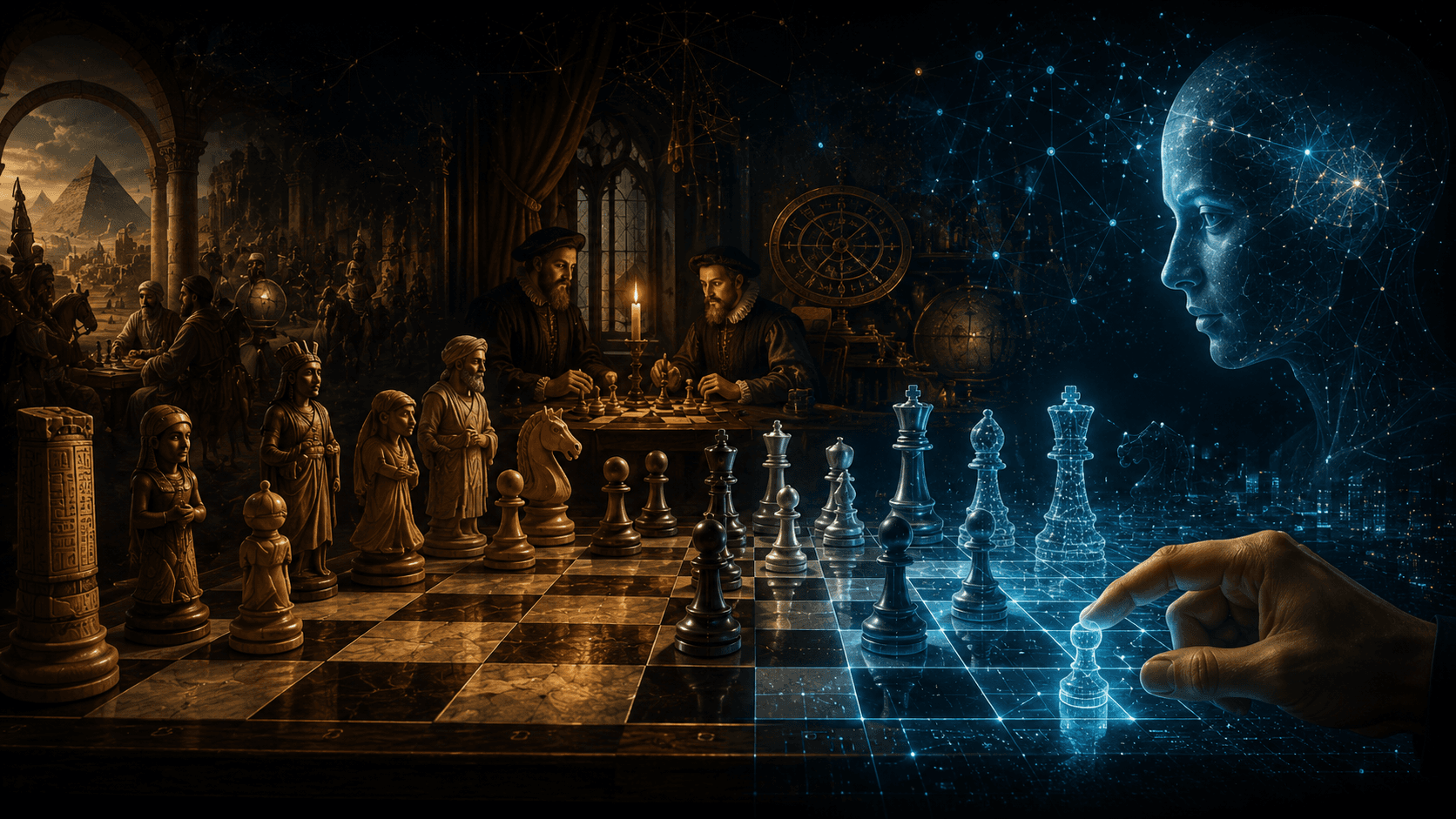
Chess has traveled remarkably far from its ancient origins.
Its earliest ancestors emerged in India more than a millennium ago before evolving through Persia, the Islamic world, medieval Europe, imperial courts, public cafés, international tournaments, school clubs, computers, and finally the internet.
Few cultural practices have crossed so many political, linguistic, and technological boundaries while retaining such a recognizable core.
Then came computers.
For much of the twentieth century, defeating the world's strongest chess player became a symbolic challenge for artificial intelligence. When IBM's Deep Blue defeated Garry Kasparov in a celebrated 1997 match, the event was interpreted by many as a confrontation between human and machine intelligence.
But the long-term result was more interesting than simple replacement.
Computers transformed chess into a collaboration.
Today's players use engines to analyze openings, test strategic assumptions, uncover defensive resources, and revisit historical games. Machines routinely discover moves that generations of humans overlooked.
Yet humans still play.
Millions of them.
Because chess was never valuable merely because humans were the best at it.
We continue to run despite cars being faster. We calculate despite computers being better calculators. We paint despite cameras. We play chess despite engines.
The purpose is not simply to achieve the most accurate move ever produced.
The purpose is to think.
The Digital Renaissance
Chess has undergone another transformation in the twenty-first century.
Online platforms have made it possible to play an opponent anywhere in the world within seconds. Streaming has turned elite players into entertainers and educators. Short-form videos explain tactical ideas to audiences who may never have entered a traditional chess club. Competitive chess has become simultaneously more global and more personal.
The old image of chess as an isolated intellectual pastime has become increasingly outdated.
Today, a teenager can watch a grandmaster analyze a tournament from another continent, play twenty blitz games before breakfast, solve tactical puzzles on a phone, study an opening with an engine, and compete internationally without leaving home.
Technology has accelerated chess dramatically.
But the central experience remains unchanged.
Two minds encounter the same position.
One move must be chosen.
Losing Well
Chess offers many pleasures, but it also teaches defeat with unusual clarity.
When a player loses a serious game, the evidence remains on the board. There is usually a moment—or several moments—where a better decision existed.
This can be painful.
Yet it is precisely what makes chess such an effective instrument for improvement.
The player can return to the game afterward and ask: Where did my evaluation go wrong? What did I overlook? Was the mistake tactical, strategic, psychological, or practical? Did I calculate poorly, misunderstand the position, or spend too much time searching for perfection?
Failure becomes analyzable.
Strong chess players develop the ability to separate ego from error. They understand that making a bad move does not prove that they are incapable of making good ones. The goal is not to defend the mistake but to understand it.
This habit is far more valuable than chess alone.
Progress begins where self-justification ends.
Why Chess Endures
There are games with richer graphics, larger worlds, more characters, faster action, and more elaborate rules.
Chess needs none of them.
Its simplicity is exactly what allows its complexity to become infinite.
The board is small enough to understand but too deep to exhaust. A child can learn the legal moves, yet no human can master every possibility. Players can devote entire careers to a single opening variation and still encounter novelty. Positions studied for centuries can suddenly reveal new ideas.
Chess lives in that extraordinary territory between the comprehensible and the unknowable.
We understand enough to play.
Never enough to finish discovering.
Perhaps that is why the game has survived kingdoms, revolutions, wars, technologies, fashions, and generations of players.
Every chess game begins exactly as countless others have begun before it.
The pawns stand ready.
The kings wait behind them.
The board contains no history yet.
Then someone moves.
And an entirely new world begins.
Loading the conversation…