

A chess engine can settle an argument in a fraction of a second. It can show that one move wins, another holds, and the move played loses. For a computer, that may be a complete answer. For a player trying to improve, it is often only a better description of the confusion.
The gap between analysis and teaching is not calculation. It is translation.
A teacher has to understand what the student could reasonably notice, which alternatives deserved attention, and what idea will remain useful after the current position disappears. The strongest line matters, but so do the clues that make the line findable.
Begin before the mistake
Post-game analysis usually marks the move where an evaluation changed. That point is mathematically precise and pedagogically incomplete. Many mistakes begin earlier: a player stopped asking what the opponent wanted, spent too much time on a harmless decision, or entered a position without recognizing the plan it required.
A useful review looks upstream. It asks when the position changed character and what should have triggered a fresh calculation. Perhaps a file opened toward the king. Perhaps a defender became overloaded. Perhaps a quiet pawn move removed the only safe retreat square.
These are portable clues. “Move 24 was a blunder” belongs to one game. “When a defender is pinned, count what it no longer protects” belongs to the player's future.
Compare human candidates
Engines are excellent at revealing moves no person considered. Those discoveries are part of chess's beauty, but they can crowd out a more practical question: why did the move that felt natural fail?
Good instruction takes the player's candidate seriously. It compares the intention behind that move with what the position demanded. If the player attacked because they sensed an exposed king, the lesson may be about timing rather than aggression. If they traded to simplify, the missing idea may be that the resulting pawn ending was not actually safe.
This distinction protects confidence without protecting errors. The point is not to flatter the decision. It is to make the correction precise enough to use.
Explain at the right depth
The same engine line can teach different lessons at different levels. A beginner may need to see that a loose piece was attacked twice and defended once. A stronger player may need to understand why a seemingly active move surrendered control of a key square. Dumping the full variation on both players is accurate but not adaptive.
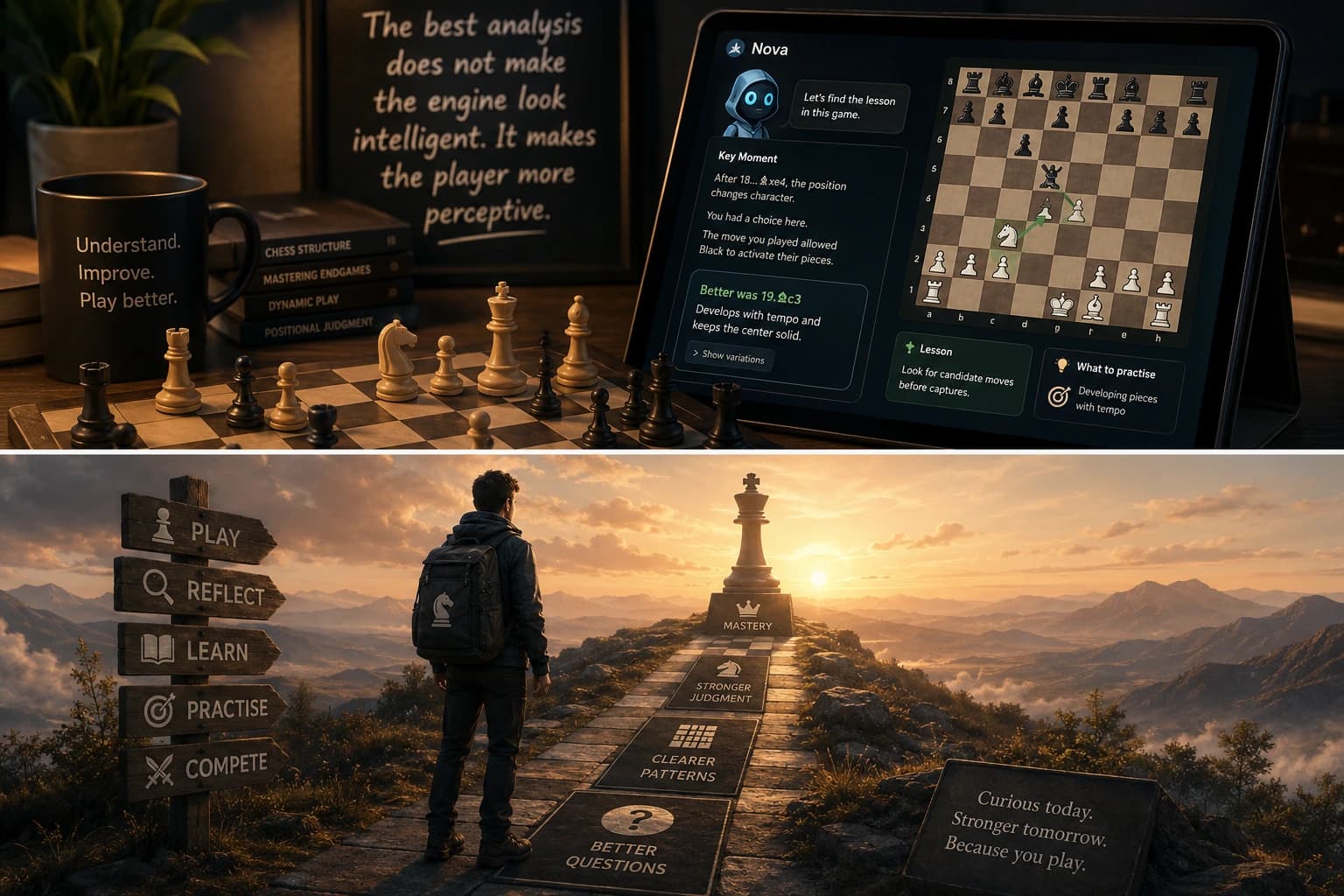
Nova AI in BM Chess is designed around this translation problem. An explanation should use enough depth to establish the claim, then return to the human idea. More branches are not automatically more helpful. Often the right output is one critical line, one rejected alternative, and one sentence about what to watch next time.
Keep uncertainty honest
Not every position has a single teachable truth. Engines can disagree at shallow depth, practical choices can differ from theoretical ones, and a move that is objectively second-best may be the best decision available under time pressure.
A coach should be able to say that. It should distinguish a forced tactic from a strategic preference and a decisive error from a difficult choice. False certainty makes analysis feel authoritative while making learning brittle.
Chess is played by people with clocks, nerves, habits, and incomplete information. Instruction that ignores those conditions explains a different game.
Return the board to the player
The final test of review is not whether the analysis screen is impressive. It is whether the player sees more when the pieces are reset.
That may mean remembering to scan checks, captures, and threats. It may mean recognizing a familiar pawn break, noticing when a good piece has no future, or pausing before an automatic recapture. Small improvements in perception compound because they change which decisions become available.
An engine tells us what the position contains. A teacher helps us become the kind of player who can find more of it. BM Chess needs both, but it should never confuse one for the other.

Loading the conversation…