For most of human history, wealth was conspicuous.
It was land, gold, servants, silk, marble, horses, square footage. You could usually see it from across the street.
Modern wealth is becoming harder to photograph.
The person with the most expensive life in the room may not be wearing the most expensive watch. They may simply have the fewest irreversible commitments.
They can leave a bad job without calculating whether rent is due next Friday. They can walk away from a manipulative client. They can spend Tuesday afternoon with a sick parent. They can abandon a project that no longer makes sense, move cities, take six months off, retrain, start again.
They possess something more powerful than luxury:
optionality.
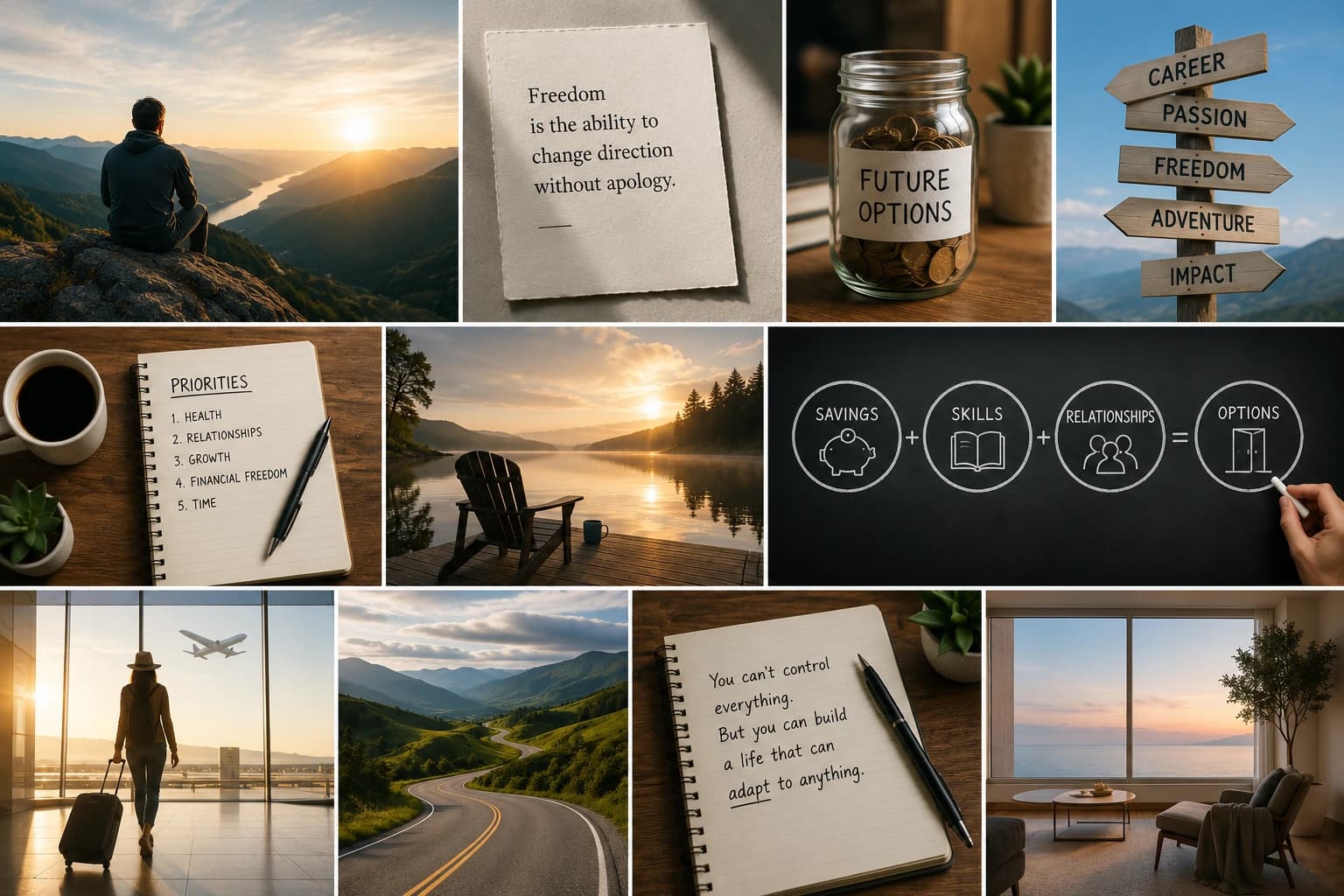
Optionality is the ability to delay commitment, absorb mistakes, exploit unexpected opportunities and change direction without catastrophe.
It is one of the least discussed forms of wealth because it does not advertise itself. There is no obvious status symbol for having three years of living expenses in the bank, a portable career, strong friendships in five cities and a calendar with white space.
Yet these things may matter far more than the objects we traditionally associate with success.
The central financial mistake of modern life is that people often use money to purchase things that reduce their future freedom.
They become richer in possessions and poorer in possibilities.
The Golden Handcuffs Are Usually Purchased Voluntarily
Imagine two professionals who each earn $200,000 a year.
The first has a large mortgage, two leased cars, private-school tuition, club memberships, expensive annual vacations and a lifestyle that requires roughly $14,000 every month to maintain.
The second lives comfortably but requires $6,000.
On paper, they have similar incomes.
In practice, they inhabit different economic realities.
The second person can tolerate unemployment longer. They can accept a temporary pay cut to enter a better field. They can finance a small business. They can refuse a promotion that comes with unbearable political costs. They can relocate. They can take care of someone.
The first person may earn more and feel poorer.
This is one of the strange properties of lifestyle inflation: every recurring expense converts a portion of future income into an obligation.
A $1,500 monthly payment is not merely $1,500.
It is a small claim on your future labor.
Enough claims accumulate and your impressive salary begins to resemble a pipeline carrying money from your employer to everyone else.
This explains why some high earners become unusually risk-averse.
From the outside, they look powerful.
Internally, they know the machine cannot stop.
Their lifestyle has developed a burn rate.
And burn rates create obedience.
Money Has Two Functions
We usually think of money as having one purpose: purchasing.
It buys food, housing, travel, entertainment, education and objects.
But money has a second function that may be more important.
It allows you not to do things.
Not to accept the first offer.
Not to remain in a destructive environment.
Not to sell during a panic.
Not to turn every hobby into a side hustle.
Not to answer every email immediately.
Not to tolerate disrespect because the alternative is insolvency.
In this sense, savings purchase absence.
They purchase the absence of desperation.
That is difficult to display on social media, which may explain why consumer culture systematically underprices it.
A designer bag generates a visible event.
A healthy emergency fund mostly generates nothing.
No crisis.
No humiliation.
No panicked phone call.
No need to borrow from the wrong person.
The benefit is an event that never occurs.
Our minds are bad at valuing such things.
We notice the vacation we purchased.
We rarely notice the nervous breakdown we avoided by having enough financial runway to leave.
The Best Opportunities Rarely Arrive on Schedule
There is another reason optionality matters.
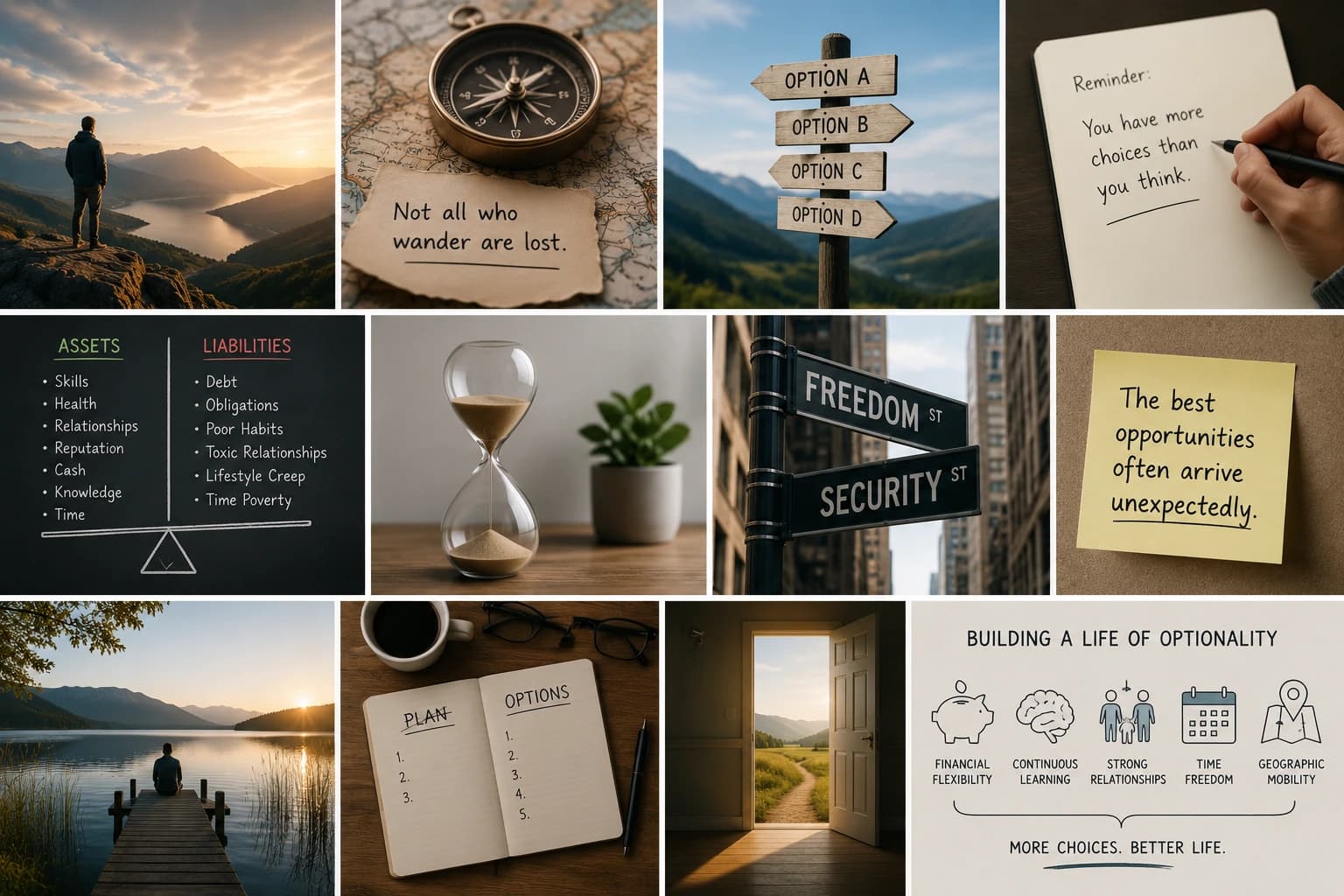
Life's unusually valuable opportunities tend to be inconvenient.
A fascinating company wants you to join, but you would need to move.
Someone offers you a partnership, but the first year may pay almost nothing.
A person you love gets an opportunity overseas.
An undervalued asset becomes available during a recession.
A mentor invites you onto a project that conflicts with your existing schedule.
You discover, somewhat painfully, that the career you spent a decade constructing is not the career you want.
These moments cannot always be anticipated.
You cannot place "unexpected life-changing opportunity" in next year's budget.
You can only build a life capable of responding when one appears.
That is what optionality does.
It is stored responsiveness.
And because the future is uncertain, stored responsiveness has extraordinary value.
The financial system understands this concept extremely well. Options are literally priced assets. Corporations pay for unused credit facilities. Investors willingly sacrifice some expected return for liquidity.
Individuals, strangely, are often encouraged to do the opposite.
Every spare dollar should be "put to work."
Every empty room should be monetized.
Every free evening should become productive.
Every unused capacity appears inefficient.
But efficiency and resilience are not the same thing.
A system operating at 100 percent capacity has no room for surprise.
Neither does a person.
Your Calendar Has a Balance Sheet
Optionality is not exclusively financial.
Time has liquidity too.
Consider two people with identical salaries and identical savings.
One has every weekday packed with meetings, every weekend planned six weeks in advance and dozens of low-grade obligations scattered across their life.
The other deliberately maintains empty space.
Again, they appear economically identical.
They are not.
One possesses temporal capital.
The ability to take a meeting tomorrow.
To spend an afternoon reading something difficult.
To help a friend.
To follow curiosity.
To recover.
To think.
Modern professionals often destroy this form of wealth because empty time looks suspicious.
A blank calendar can feel like underachievement.
So we fill it.
The problem is that some of the highest-value activities in life require slack.
Strategic thinking requires slack.
Creativity requires slack.
Friendship requires slack.
Serendipity requires slack.
Even love is difficult to schedule efficiently.
When every hour has been pre-allocated, unexpected opportunity becomes an interruption rather than an invitation.
There is a reason powerful people often employ others to protect their calendars.
Control of one's time is one of the oldest privileges of wealth.
Career Capital Is Really Exit Capital
The same principle applies professionally.
People frequently optimize their careers for compensation while ignoring portability.
But the most valuable career may not be the one that pays the most this year.
It may be the one that continually increases the number of places you could work next year.
Certain skills generate optionality because they transfer.
Writing.
Selling.
Managing.
Programming.
Negotiating.
Speaking.
Understanding finance.
Building an audience.
Operating across cultures.
Developing genuine expertise in a difficult domain.
These abilities are valuable partly because they weaken the dependence between you and any single institution.
A title can disappear during a reorganization.
A company's prestige can evaporate.
An industry can decline.
Portable competence survives.
This changes workplace psychology in subtle ways.
The employee who believes, "I could find another excellent job," behaves differently from the employee who believes, "I need this particular job."
They negotiate differently.
They speak differently.
They evaluate bad leadership differently.
Their confidence is not necessarily personality.
It may be balance-sheet strength expressed through behavior.
This is why the best form of career security is often not making yourself impossible to fire.
It is making firing you survivable.
Relationships Also Contain Optionality
This principle becomes uncomfortable when applied to relationships because it sounds transactional.
It does not need to be.
A person with deep friendships, strong family connections, professional goodwill and a reputation for reliability possesses a social form of resilience.
When something breaks, there are people to call.
When they move, someone knows someone.
When their company fails, someone remembers their work.
When grief arrives, someone brings dinner.
Social capital is frequently discussed as though it were merely networking.
That dramatically understates its importance.
Real social capital is distributed mutual trust.
And like financial capital, it becomes especially valuable during disorder.
The problem is that social optionality cannot be manufactured instantly.
You cannot neglect everyone for ten years and then urgently acquire a community during a crisis.
Relationships compound slowly.
Small acts of generosity become memories.
Reliability becomes reputation.
Shared experiences become trust.
The return is uncertain and irregular, which makes the investment appear inefficient.
Until the day it becomes priceless.
Why Successful People Accidentally Destroy Optionality
The tragedy is that conventional success often encourages people to exchange optionality for symbols of success.
A promotion increases income.
The increased income justifies a more expensive house.
The house creates a longer commute.
The commute creates a need for convenience.
Convenience increases spending.
The larger lifestyle makes the salary indispensable.
The indispensable salary makes career experimentation impossible.
The promotion that appeared to expand freedom eventually reduces it.
Nothing catastrophic happened.
Each decision was locally reasonable.
The trap was created gradually.
This is how many sophisticated cages are built.
Not with one terrible choice, but with hundreds of individually defensible ones.
The same thing happens with reputation.
Someone becomes known as the person who always delivers.
They accept more projects.
More people depend on them.
Their calendar fills.
Their income rises.
Their status rises.
Their freedom quietly collapses.
Success creates surface area.
Surface area creates obligations.
Obligations create fragility.
Without deliberate resistance, the natural direction of an ambitious life may be toward higher output and lower maneuverability.

The Optionality Test
There is a useful way to evaluate major decisions.
Instead of asking only:
"What will this give me?"
Ask:
"What will this prevent me from doing later?"
A house may give you stability.
It may also make relocation harder.
A prestigious job may give you status.
It may also consume the energy required to build something of your own.
A luxury purchase may give you pleasure.
It may also raise the psychological baseline of what you consider normal.
A business partnership may give you resources.
It may also constrain future strategic decisions.
Marriage, children, careers, cities and companies obviously should not be judged purely on optionality. Some of life's greatest commitments are valuable precisely because they close other doors.
But that makes the distinction more important, not less.
You should know when you are closing a door.
Optionality is not the goal of life.
It is the resource that allows you to choose your commitments rather than stumble into them.
There is a profound difference.
Freedom Often Looks Like Under-Optimization
A strange conclusion follows.
Many financially sensible decisions will appear suboptimal on a spreadsheet.
Keeping too much cash may reduce investment returns.
Living below the maximum house you can afford may appear unnecessarily conservative.
Turning down additional work may reduce annual income.
Leaving parts of your calendar empty may look unproductive.
Maintaining skills outside your current role may seem unfocused.
These decisions sacrifice measurable efficiency in exchange for invisible flexibility.
Economists sometimes describe this tension as the difference between optimization and robustness.
The perfectly optimized system performs beautifully under expected conditions.
The robust system survives unexpected ones.
Human lives encounter unexpected conditions constantly.
Industries disappear.
Parents get sick.
Technologies emerge.
Relationships end.
Markets crash.
Cities change.
Children arrive.
Companies restructure.
People themselves change.
A 25-year-old can make a perfectly rational plan for the preferences of a person who no longer exists at 35.
Optionality creates room for that person to renegotiate the contract.
The Ultimate Status Symbol Is Needing Less
There is a final paradox.
People often pursue wealth because they want autonomy.
But wealth displays frequently require maintenance, attention and recurring expenditure—the very things that reduce autonomy.
The expensive house requires upkeep.
The complicated investment structure requires management.
The packed social calendar requires attendance.
The prestigious position requires performance.
The luxury lifestyle requires continued earning.
Eventually, the owner begins serving the assets.
There is nothing inherently wrong with expensive things. Some are wonderful.
The mistake is failing to calculate their freedom-adjusted cost.
The truly luxurious purchase may not be another object.
It may be a year of runway.
A mortgage small enough to ignore.
A skill that works in several industries.
A passport and the ability to use it.
A strong body.
A quiet morning.
An excellent reputation.
A friend who would answer at 3 a.m.
A business that can operate without you for two weeks.
A life whose fixed costs are low enough that saying "no" remains economically possible.
These things rarely signal wealth effectively.
They do something better.
They create it.
Because wealth, at its deepest level, is not the number of things you can purchase.
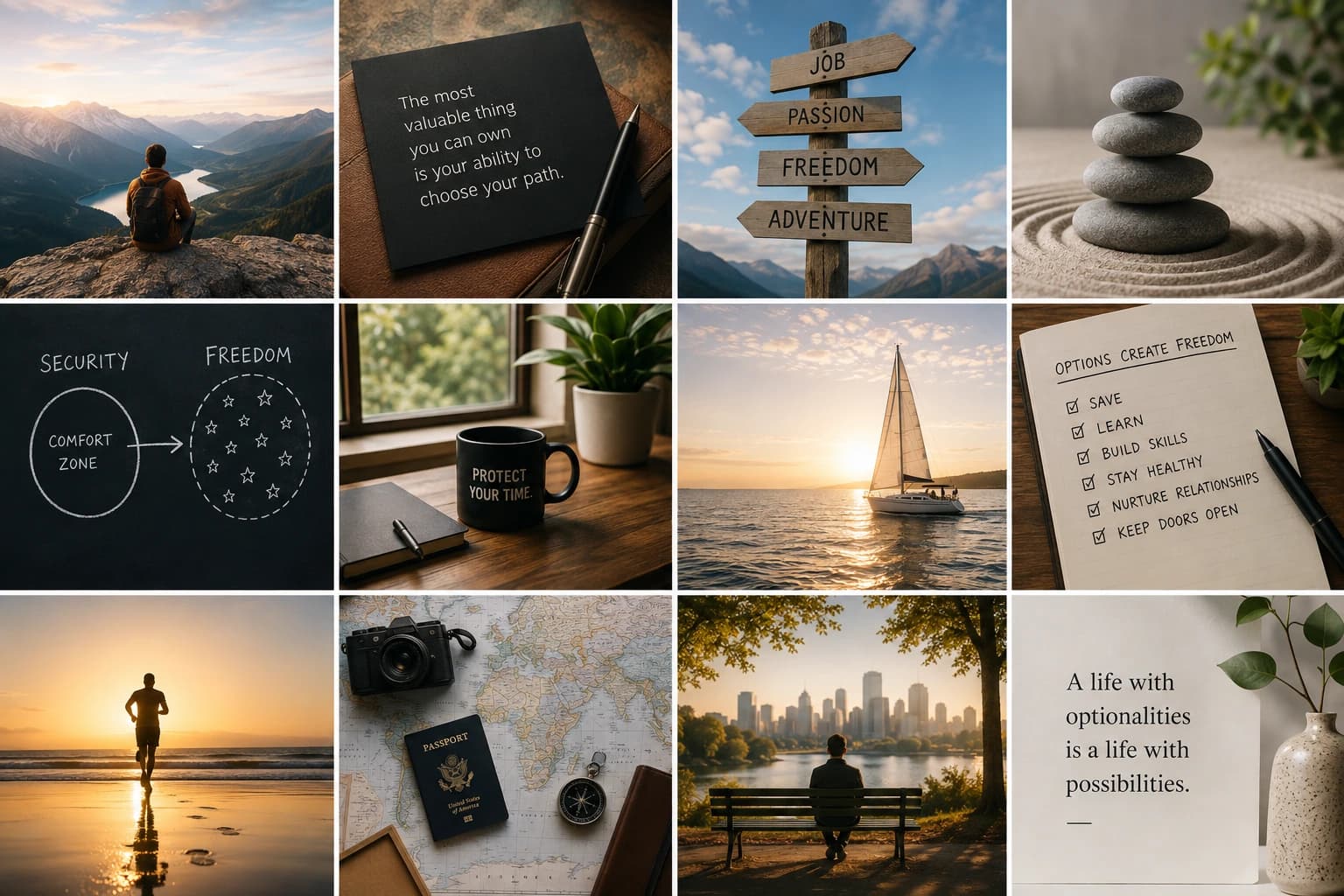
It is the number of decisions you are still free to make.



Loading the conversation…