
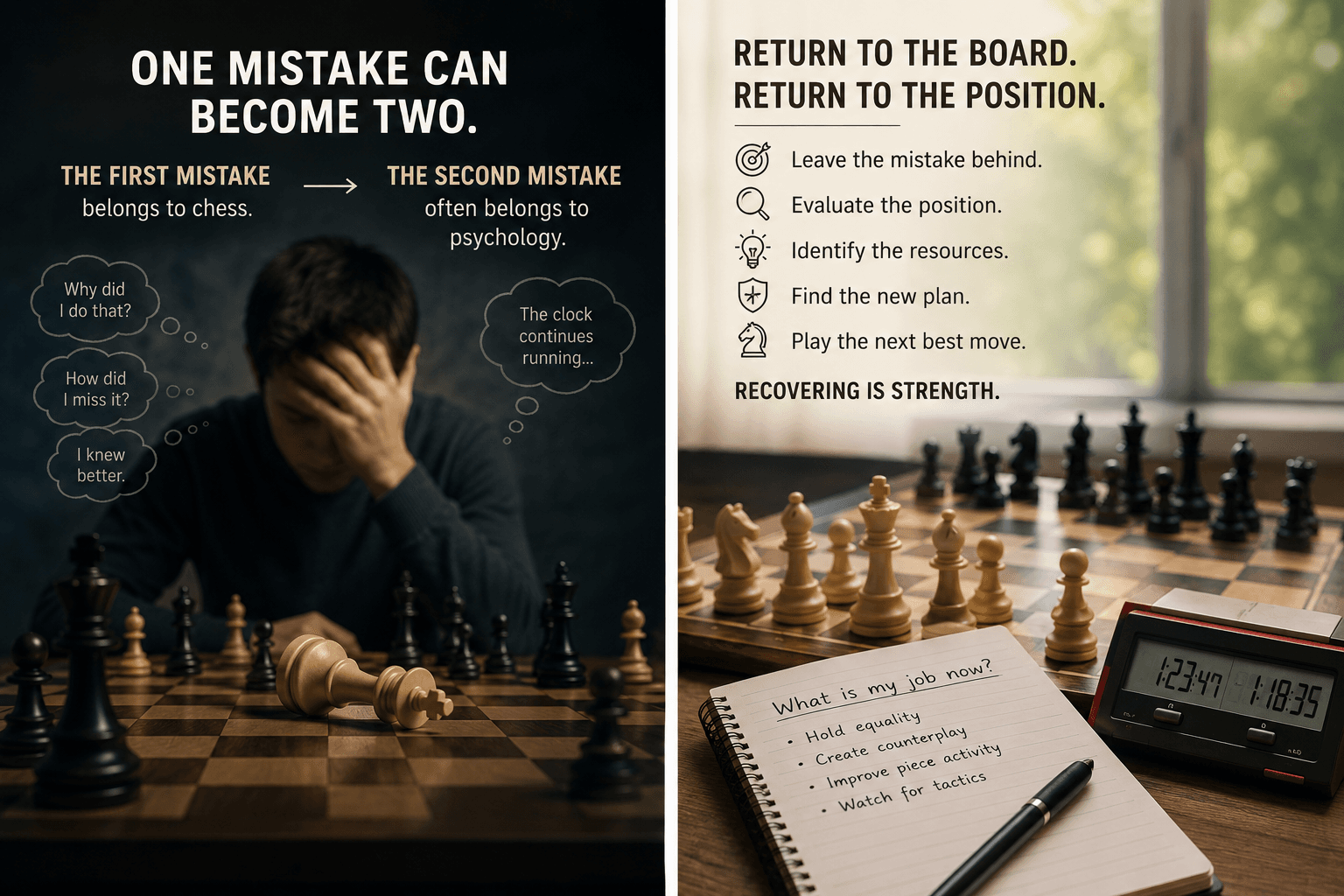
A bad move changes the position once. The reaction to it can change the position again. Learning to recover is not separate from chess strength—it is one of its purest forms.
BM / Journal Chess & learning
You know the feeling before the engine confirms anything.
Something is wrong.
Perhaps your opponent makes a reply you did not consider.
Perhaps a tactic appears one move too late in your mind.
Perhaps the piece you thought was defended is not defended at all.
The position has changed.
Then something else happens.
You begin replaying the mistake.
Why did I do that?
How did I miss it?
I knew better.
The clock continues running while you argue with a position that no longer exists.
And this is where one mistake can become two.
Chess punishes memory at the wrong moment
After a serious error, the mind naturally travels backward.
It searches for the moment where the game went wrong.
This instinct is useful after the game.
During the game, it can be disastrous.
The board does not care why you blundered.
It does not restore the piece because you understand your mistake.
It does not return to the position where your advantage still existed.
Your next move must be played from here.
That sounds obvious.
Emotion makes it difficult.
A player who was winning five minutes ago may still feel entitled to a winning position. They attack as though the advantage remains.
A player who has lost material may assume resistance is pointless and begin moving quickly.
A player embarrassed by a tactical oversight may try to repair the emotional damage with an aggressive move that has no positional justification.
The first mistake belongs to chess.
The second often belongs to psychology.
The position does not know you blundered
Imagine losing a pawn.
Before the mistake, perhaps the position was clearly better.
Afterward, perhaps it is equal.
To the player, this can feel terrible.
Something valuable has been lost.
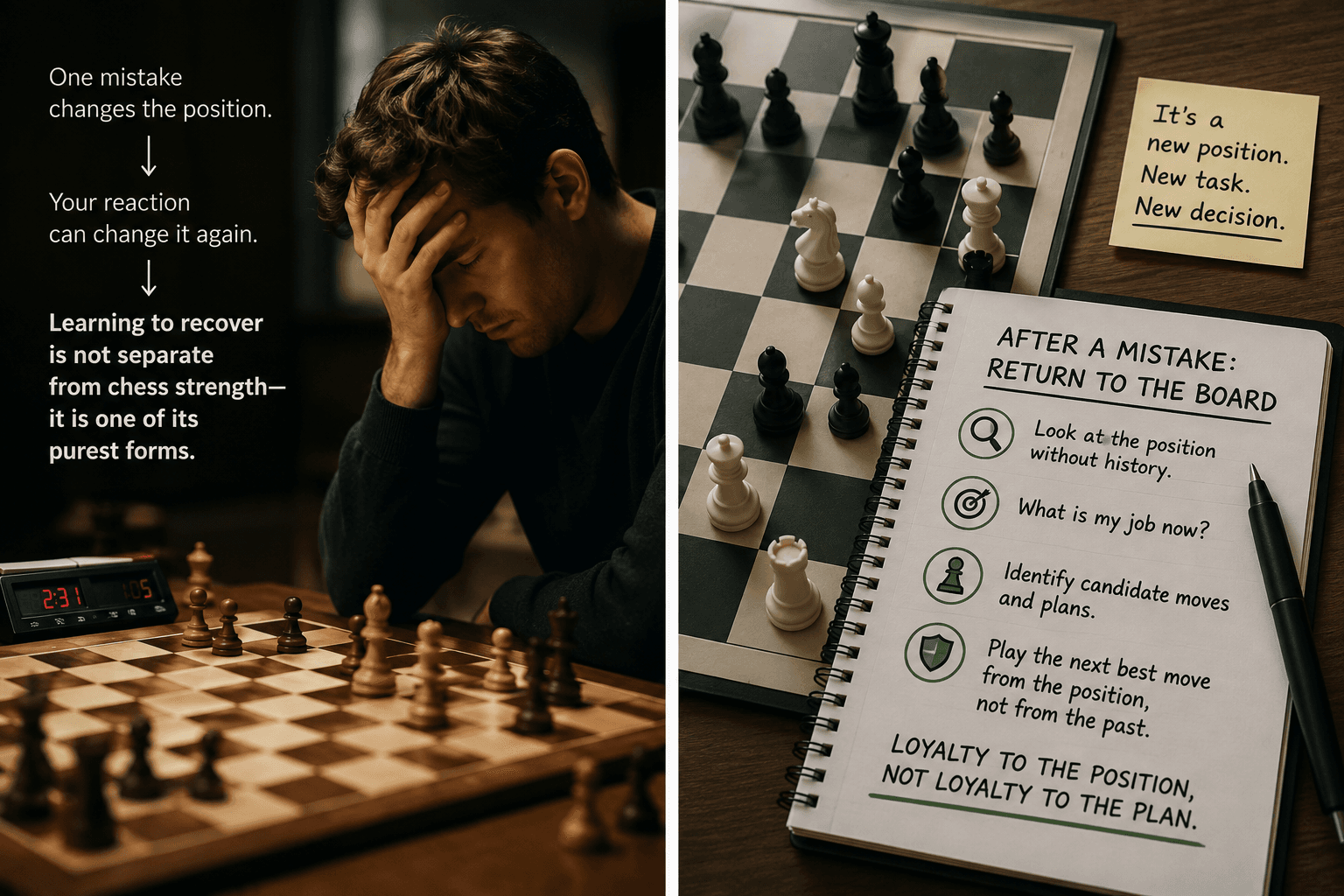
But look at the board without history.
The current position may be completely playable.
If it had appeared as the starting position of a puzzle, you might examine it calmly.
You would identify plans.
Compare pieces.
Look for weaknesses.
You might even prefer your side.
Only the memory of what came before makes the position feel unbearable.
This reveals an important distinction.
Chess has an objective position and a psychological position.
The objective position contains pieces, squares, time, structure, threats, and possibilities.
The psychological position contains expectations.
I was winning.
I should have seen that.
My opponent does not deserve this.
I have ruined the game.
Only one of these positions appears on the board.
Strong recovery begins by returning to it.
Evaluation is not emotion
Players often use emotional language as though it were analysis.
“This position is awful.”
“I have nothing.”
“The game is over.”
Sometimes those statements are accurate.
Frequently, they mean something else.
I dislike this position.
I am disappointed by how I reached it.
I do not know what to do.
I expected to be better.
These are real experiences.
They are not evaluations.
A position can be unpleasant and defensible.
Worse and complicated.
Lost but difficult to convert.
Equal but uncomfortable.
Winning but technically demanding.
Chess improvement requires increasingly precise language because language shapes attention.
If you call a difficult position hopeless, you stop looking for resources.
If you call an equal position lost because you were previously winning, you may manufacture the defeat yourself.
The board deserves a fresh evaluation.
Not an emotional summary.
A mistake changes the task
Before the error, your task may have been to convert an advantage.
After it, your task may be to hold equality.
Later, it may become creating complications.
Then defending an inferior ending.
Then constructing one final tactical problem.
Players suffer when they continue pursuing the old task after the position has assigned a new one.
This happens constantly.
A kingside attack fails, but the player keeps sending pieces toward the king.
A material advantage disappears, but the player continues exchanging pieces as though simplification still favors them.
A worse endgame arises, but the player waits passively instead of creating counterplay.
The plan was correct.
Then reality changed.
Strong chess requires loyalty to the position, not loyalty to the plan.
After a mistake, one of the most useful questions is therefore remarkably simple:
What is my job now?
Not what was it?
Not what should it have been?
Now.
Good defense is active thinking
Many players treat defense as the absence of ambition.
They would rather attack badly than defend accurately.
This is partly aesthetic. Attacking feels like playing chess. Defense can feel like waiting for something unpleasant to happen.
But strong defense is not passive.
It is a search for problems.
What does the opponent still need to accomplish?
Which piece can become active?
What trade would make conversion harder?
Where can counterplay appear?
Which pawn break changes the structure?
Which position forces the opponent to find another accurate move?
When worse, the objective changes.
You no longer need to prove that your position is good.
You need to make the opponent prove that theirs is.
That is a meaningful shift.
An advantage is not a victory.
It is an obligation to continue playing accurately.
Your job is to keep that obligation alive.
Do not demand immediate forgiveness
After making a mistake, players often seek a move that fixes everything.
A tactical trick.
A sudden attack.
A sacrifice.
Something dramatic enough to restore the previous evaluation immediately.
Usually, the board offers no such move.
The position may require patience instead.
Improve the worst piece.
Protect a weakness.
Trade an attacker.
Create an escape square.
Force the opponent to spend time improving.
Accept that the next five moves may be about survival rather than restoration.
This can feel unsatisfying because emotion wants symmetry.
A large mistake should have a large solution.
Chess rarely works that way.
Sometimes recovery consists of making four ordinary moves in a row.
Nothing is won back.
Nothing spectacular happens.
The position simply stops becoming worse.
That is progress.
The strongest players lose advantages too
It is easy to imagine that composure belongs to players who rarely make mistakes.
In reality, serious chess guarantees disappointment.
Winning positions become equal.
Equal positions become worse.
Prepared openings lead somewhere unfamiliar.
Beautiful attacks dissolve after one defensive move.
Endgames thought to be trivial refuse to cooperate.
Strength cannot mean avoiding all of this.
It must include what happens afterward.
A player who needs the game to follow the expected script will always be fragile.
A player who can repeatedly update their understanding becomes difficult to defeat.
This is not emotional indifference.
Strong competitors care deeply.
The difference is that disappointment does not receive control of the next move.
They can dislike what happened and still examine what exists.
That separation is a competitive skill.
Time pressure makes emotion expensive
A mistake does more than damage the position.
It can damage the clock.
Players spend two minutes staring at the board after a blunder that cannot be undone.
Or they react in the opposite direction and move instantly, desperate to escape the feeling of having made the mistake.
Both responses allow emotion to set the tempo.
A useful reset does not need to be elaborate.
Look at the whole board again.
What did the opponent's move change?
What is threatened?
What remains defended?
Which pieces are active?
What is the evaluation now—not ten seconds ago?
The purpose is not to become calm for the sake of calmness.
It is to restore contact with the position.
The clock should be spent solving the game that still exists.
Analysis should include the next move
Post-game analysis naturally gravitates toward the largest mistake.
The graph collapses.
The engine shows the better move.
We stare at the variation.
But sometimes the more revealing moment comes immediately afterward.
How did you respond to being wrong?
Did one blunder become three?
Did you stop calculating?
Did you become reckless?
Did you reject a patient defensive move because it felt humiliating?
Did you continue playing as though an advantage still belonged to you?
Did you resign mentally before the game ended physically?
These are repeatable patterns.
And because they repeat, they can be trained.
A useful analysis system should not only identify the move where the evaluation changed most.
It should notice how the player behaved after the change.
Some players have tactical weaknesses.
Some have positional weaknesses.
Some have recovery weaknesses.
They play excellent chess while the story makes sense, then collapse when reality contradicts it.
That is chess knowledge worth discovering.
Your opponent can make mistakes too
There is a quiet arrogance hidden inside despair.
When we make a serious mistake, we sometimes behave as though the remainder of the game has already been calculated perfectly.
We assume the opponent will find every accurate continuation.
They will convert every advantage.
They will see every resource.
They will make no mistake of their own.
But a few moves earlier, we ourselves failed to do exactly that.
Why should the opponent suddenly become infallible?
This does not justify hope without calculation.
A lost position can be lost.
A forced mate remains a forced mate.
But between equality and resignation exists an enormous territory of practical chess.
People miss tactics.
They choose the wrong plan.
They become nervous near victory.
They run low on time.
They exchange the wrong pieces.
They relax.
The position deserves to be played until its demands become clear.
Not until your disappointment becomes convincing.
Recovery is a form of strength
There is a version of chess improvement built around perfection.
Never blunder.
Calculate everything.
Know every opening.
Convert every advantage.
The fantasy is attractive.
It is also useless.
You will make mistakes.
So will every opponent you ever face.
A stronger player is not simply someone whose best chess is better.
They are someone whose chess remains functional after something goes wrong.
They can lose a pawn without losing discipline.
Lose an advantage without losing objectivity.
Miss a tactic without losing curiosity.
Enter an unpleasant position without pretending it is hopeless.
The mistake changes the board.
It does not have to change the player.
That may be one of the most practical forms of resilience chess can teach.
Not optimism.
Not denial.
Not forgetting what happened.
Something simpler.
The ability to look at a damaged position and ask the same question you would have asked before the damage:
What does this position need from me now?
Then make that move.
Loading the conversation…