
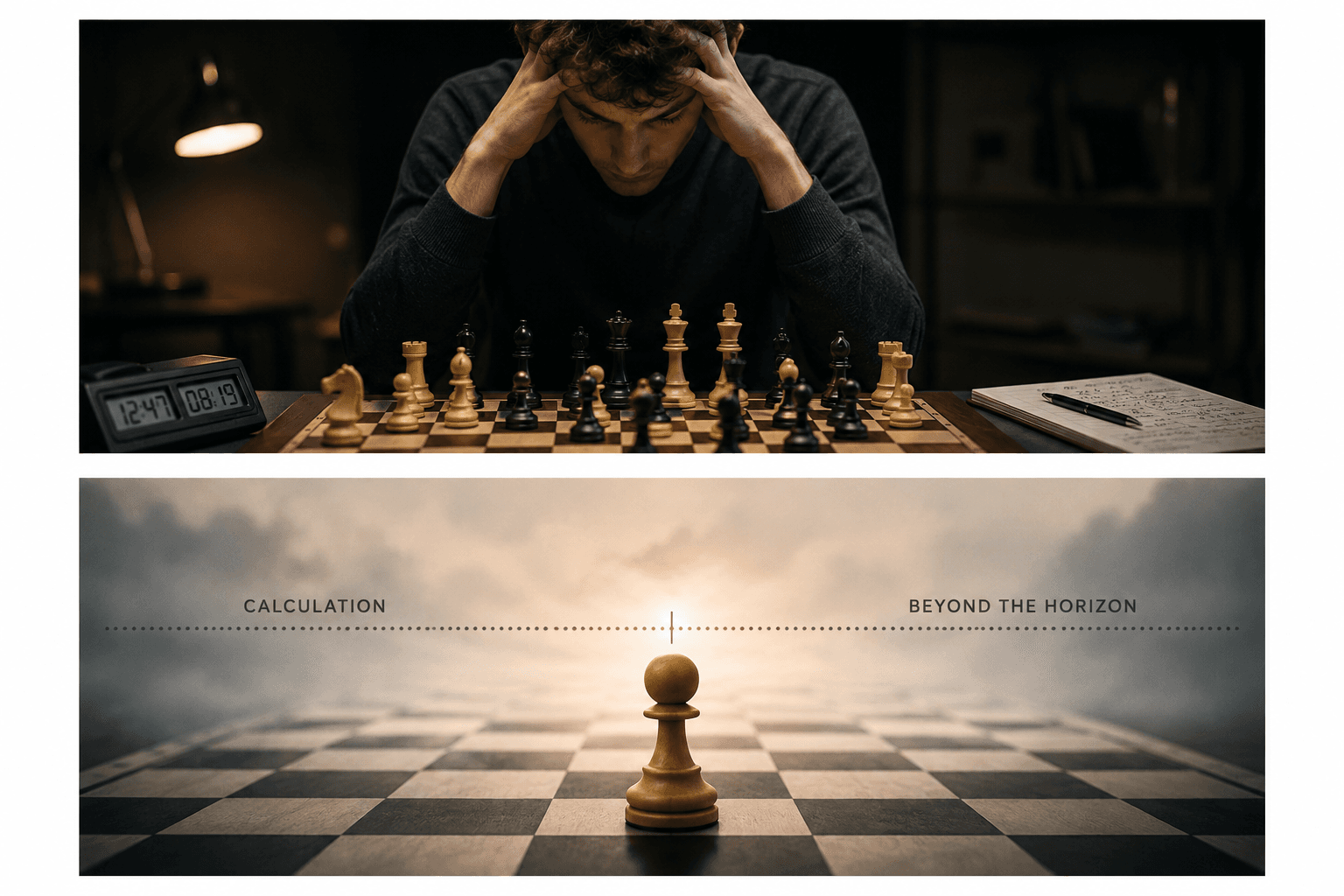
**Chess teaches us to calculate. Strong chess teaches us when calculation is no longer enough. At some point, every serious decision reaches the / Journal Chess & learning
There is a moment in almost every difficult chess game when calculation stops being comforting.
You examine one line.
Then another.
You discover a tactical resource, follow it six moves forward, reject it, return to the original position, and begin again.
The clock continues moving.
The position does not become simpler.
Eventually, something uncomfortable becomes clear.
You are going to have to make a move before you completely understand what happens next.
This is not a failure of calculation.
It is chess.
The fantasy of certainty
Players often imagine that stronger chess means becoming increasingly certain.
A beginner guesses.
An intermediate player calculates.
A master, we imagine, simply sees.
But difficult positions do not work that way.
Even the strongest player cannot resolve every branch of a complicated position. A move may lead to five serious replies. Each reply may produce several more decisions. Quiet positions can contain consequences that remain invisible for twenty moves. Tactical positions can become too dense to calculate completely within the time available.
The board may contain an objective truth.
The player still has to reach it with a finite mind and a finite clock.
That distinction matters.
Chess is a perfect-information game, but it is not a perfect-understanding game.
Everything is visible.
Very little is fully knowable.
And so the practical task is rarely:
Can I prove that this move is best?
More often, it is:
Do I understand enough to choose it?
That is a different standard.
And learning to live inside that difference is one of the deepest skills chess develops.
Calculation has a horizon
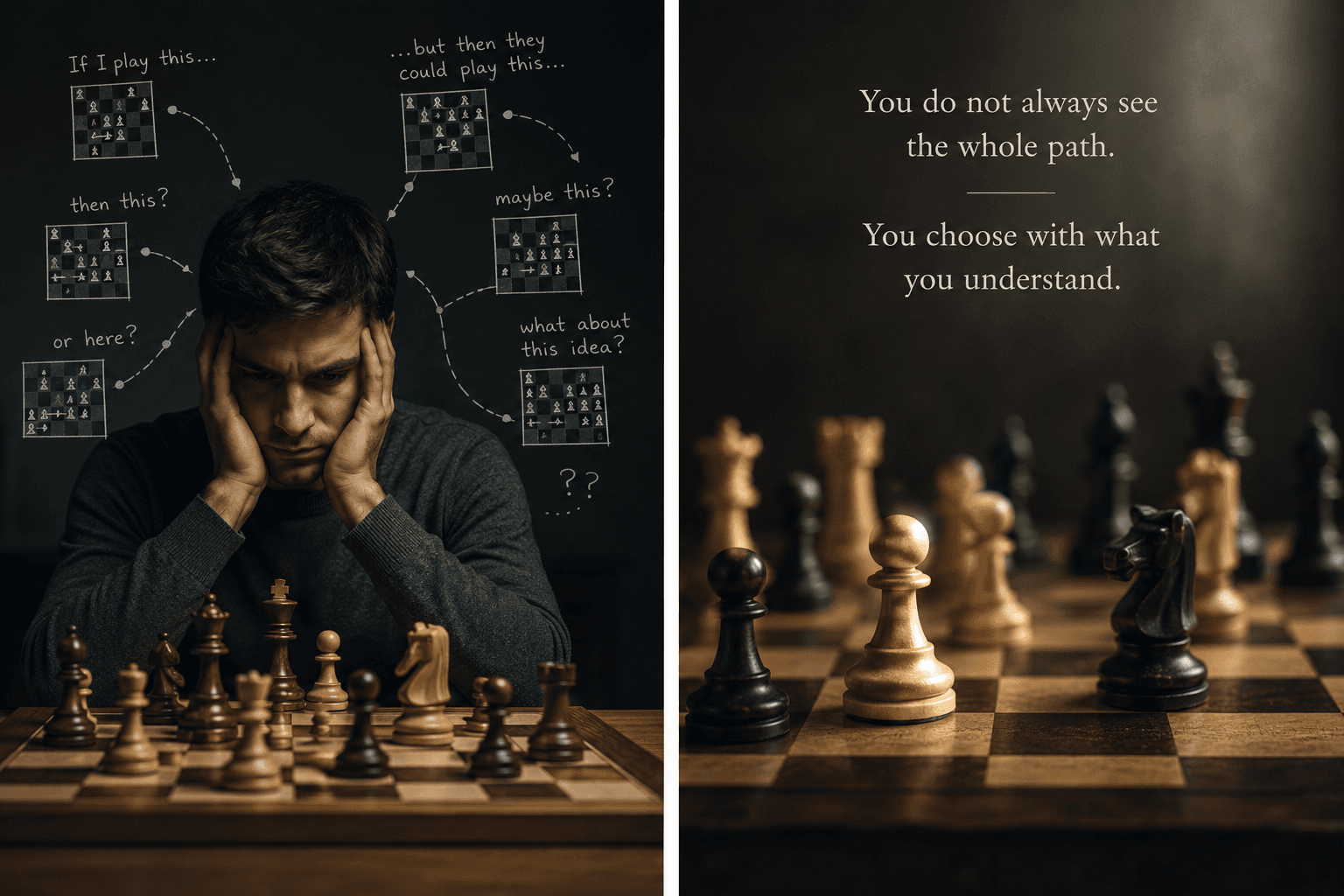
Calculation feels powerful because it turns uncertainty into sequence.
If I play this, they play that.
Then I have this.
They respond.
I respond again.
For a moment, the future seems organized.
But every calculation eventually reaches a horizon.
Beyond it sits another position.
Pieces remain on the board.
Choices remain available.
The game continues.
A player cannot calculate until checkmate from every middlegame position. At some point, the line must terminate in an evaluation:
My king is safer.
Their bishop is bad.
This ending should favor me.
The pressure appears sustainable.
I have enough compensation.
That final sentence is not calculation.
It is judgment.
Even the most concrete variation eventually rests on something less concrete.
You calculate toward a position you believe you understand.
This is why improving calculation without improving evaluation creates a strange kind of player: someone capable of seeing many moves ahead and arriving confidently at the wrong conclusion.
The line may be accurate.
The destination may be misunderstood.
Good judgment is compressed experience
Strong players sometimes make moves that appear almost suspiciously effortless.
They develop a piece.
Exchange the correct bishop.
Decline an apparently dangerous sacrifice.
Place a rook on a file that will not open for another ten moves.
Asked why, they may initially give an answer that sounds unsatisfying.
“It felt right.”
That phrase can sound mystical.
Usually, it is not.
Chess intuition is often experience that has become too compressed to narrate in real time.
Thousands of earlier positions have taught the player that certain pawn structures reward certain plans. Certain piece arrangements create tactical possibilities. Certain forms of activity are worth material. Certain attacks look frightening but lack enough participants.
The player is not consciously retrieving a library.
The library has changed what looks normal.
This is why expertise changes perception before it changes calculation.
A strong player does not merely calculate a better answer.
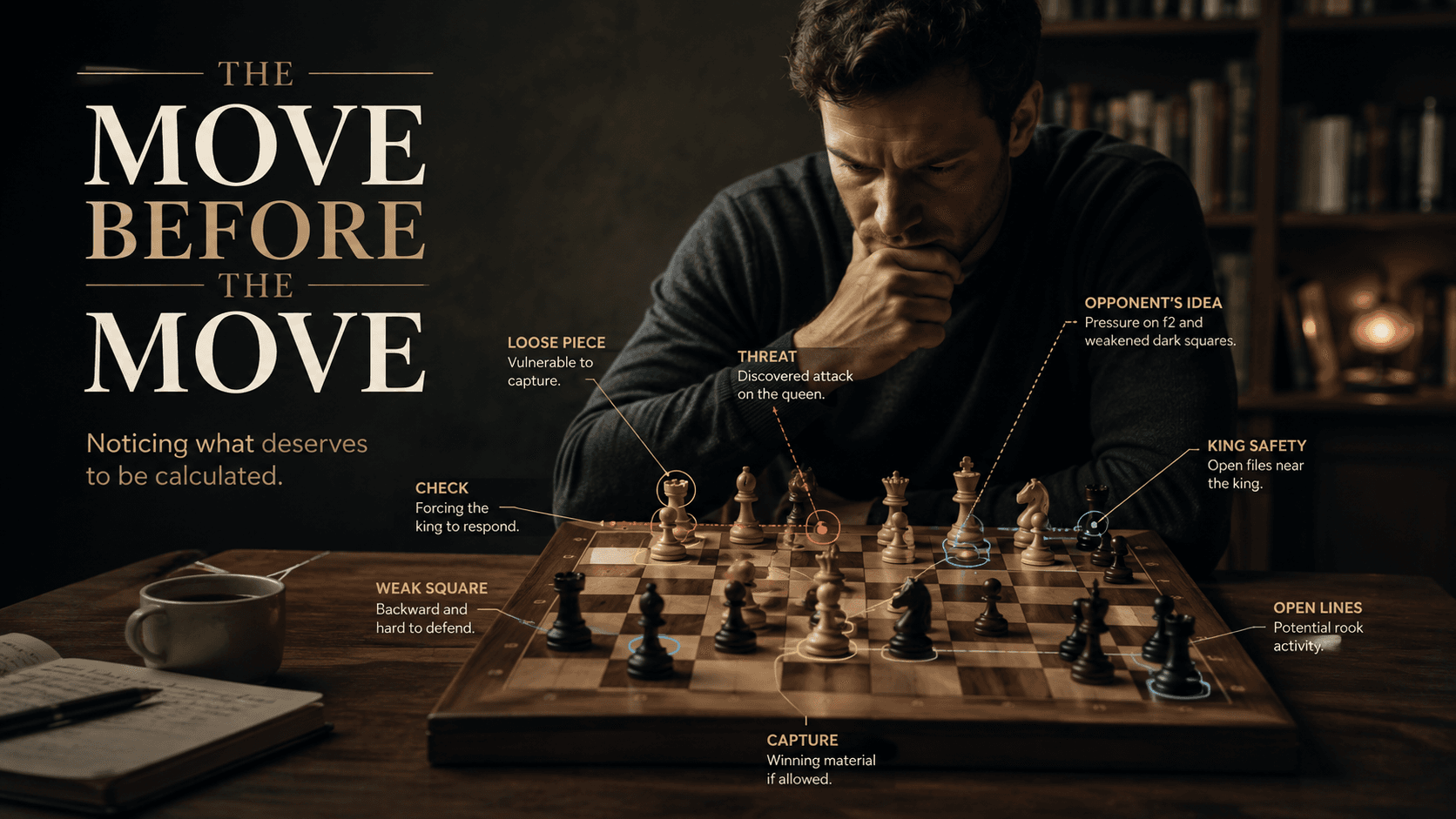
They begin from a better map of what deserves investigation.
Their uncertainty is more organized.
Some moves are impossible to love
One of the hardest chess skills is playing a move you understand but do not like.
Perhaps you must retreat.
Perhaps you must exchange your best attacking piece.
Perhaps you must return material.
Perhaps the position you wanted has disappeared, and the strongest move accepts a quieter, less ambitious reality.
These decisions are difficult because calculation is not the only force acting on the player.
Narrative is also present.
We become attached to plans.
We want the kingside attack to work because we have spent six moves preparing it.
We want our sacrifice to be correct because admitting otherwise feels like admitting that an earlier decision failed.
We want to preserve the bishop because we have spent the entire game calling it our best piece.
But the board has no loyalty to our story.
It only contains the position that exists now.
A good decision sometimes requires abandoning the explanation we had been giving ourselves about the game.
That can feel like uncertainty.
Often it is accuracy.
Confidence is not the same as clarity
Chess produces a dangerous emotional shortcut.
A move that feels clear can seem more correct than a move that feels uncertain.
This is understandable.
Confidence reduces mental friction.
Once we become convinced that a plan works, calculation becomes easier. Alternatives disappear. Doubt quiets down.
But psychological certainty is not chess certainty.
You can be completely convinced and completely wrong.
In fact, some of the worst mistakes occur precisely because uncertainty vanished too early.
The obvious recapture.
The automatic developing move.
The attack that “must” work.
The endgame that “has to” be winning.
Strong decision-making therefore requires an unusual relationship with confidence.
You need enough confidence to act.
But not so much that you stop inspecting your assumptions.
The useful question is not:
How certain do I feel?
It is:
What would have to be true for this move to be wrong?
That question turns doubt from paralysis into investigation.
The clock changes what truth means
Given unlimited time, a player might resolve more of the position.
Chess does not give unlimited time.
This transforms decision-making.
A move can be theoretically excellent but practically disastrous if finding it consumes the time needed to survive the rest of the game.
A slightly inferior move may be the better practical choice if its consequences are understandable and the alternatives require impossible precision.
This does not mean the objective evaluation stops mattering.
It means a player must solve two problems at once.
What does the position require?
And how much certainty can I afford to purchase?
Every additional minute spent calculating has a cost.
Sometimes the position deserves it.
Sometimes the pursuit of certainty becomes its own blunder.
The player searches for a proof that the game does not require and arrives at move forty with twenty seconds remaining.
Time management is therefore not separate from chess understanding.
It is an expression of it.
To use time well, you must know which positions deserve doubt.
Not all uncertainty is equal
There are positions where uncertainty should alarm you.
Your king is exposed.
A piece may be trapped.
A forcing sequence has begun.
One inaccurate move could lose immediately.
Slow down.
There are other positions where uncertainty is simply part of the landscape.
Two reasonable plans exist.
Several moves preserve the balance.
The consequences are strategic rather than tactical.
No immediate punishment is waiting.
Here, demanding complete certainty can be wasteful.
The mature player learns to distinguish between dangerous uncertainty and unavoidable uncertainty.
That distinction changes everything.
The goal is not to remove doubt from chess.
It is to know when doubt contains information.
Sometimes hesitation means you have detected a tactical problem before consciously identifying it.
Sometimes it means two moves are genuinely close.
Sometimes it means you have not understood the position.
Sometimes it means you understand the position perfectly well but dislike what it is asking you to do.
Those are different experiences.
They should not receive the same response.
Engines know. Players decide.
Modern engines create the impression that every chess question has an immediate answer.
A number appears.
A move rises to the top.
The ambiguity collapses.
This is extraordinarily useful after the game.
During the game, it can distort how we imagine thinking should feel.
The engine's certainty is not available to the player sitting at the board.
Nor should the purpose of analysis be to pretend that it was.
A useful post-game review asks more than whether the player found the engine's first choice.
It asks what could reasonably have been known at the moment of decision.
What clues were available?
Which variation deserved calculation?
Was the position tactical enough to demand precision?
Was there a safer move that preserved the important features?
Did the player reject a good move because its result looked unfamiliar?
Did they continue calculating because they lacked judgment—or because the position genuinely required it?
Analysis becomes more useful when it reconstructs uncertainty instead of erasing it.
The goal is not to look back at every decision with machine-like certainty.
It is to develop better uncertainty next time.
A move is a commitment
Eventually, the clock forces a decision.
The piece must be touched.
The move must be played.
The position that contained possibilities becomes the position that contains consequences.
There is something severe and useful about this.
Chess does not allow us to remain indefinitely in consideration.
A thought must eventually become an action.
And every action closes doors.
The skill is not making decisions without uncertainty.
No serious player gets that luxury.
The skill is learning how much understanding is enough.
Enough calculation to eliminate the obvious danger.
Enough positional judgment to evaluate what remains.
Enough humility to consider an alternative.
Enough courage to stop searching when the search has ceased to improve the decision.
Then you move.
Not because every question has been answered.
Because the position has told you enough.
Chess mastery is often described as seeing farther into the future.
Sometimes it is.
But there is another kind of mastery.
Knowing exactly where certainty ends.
And still being able to play.
Loading the conversation…