
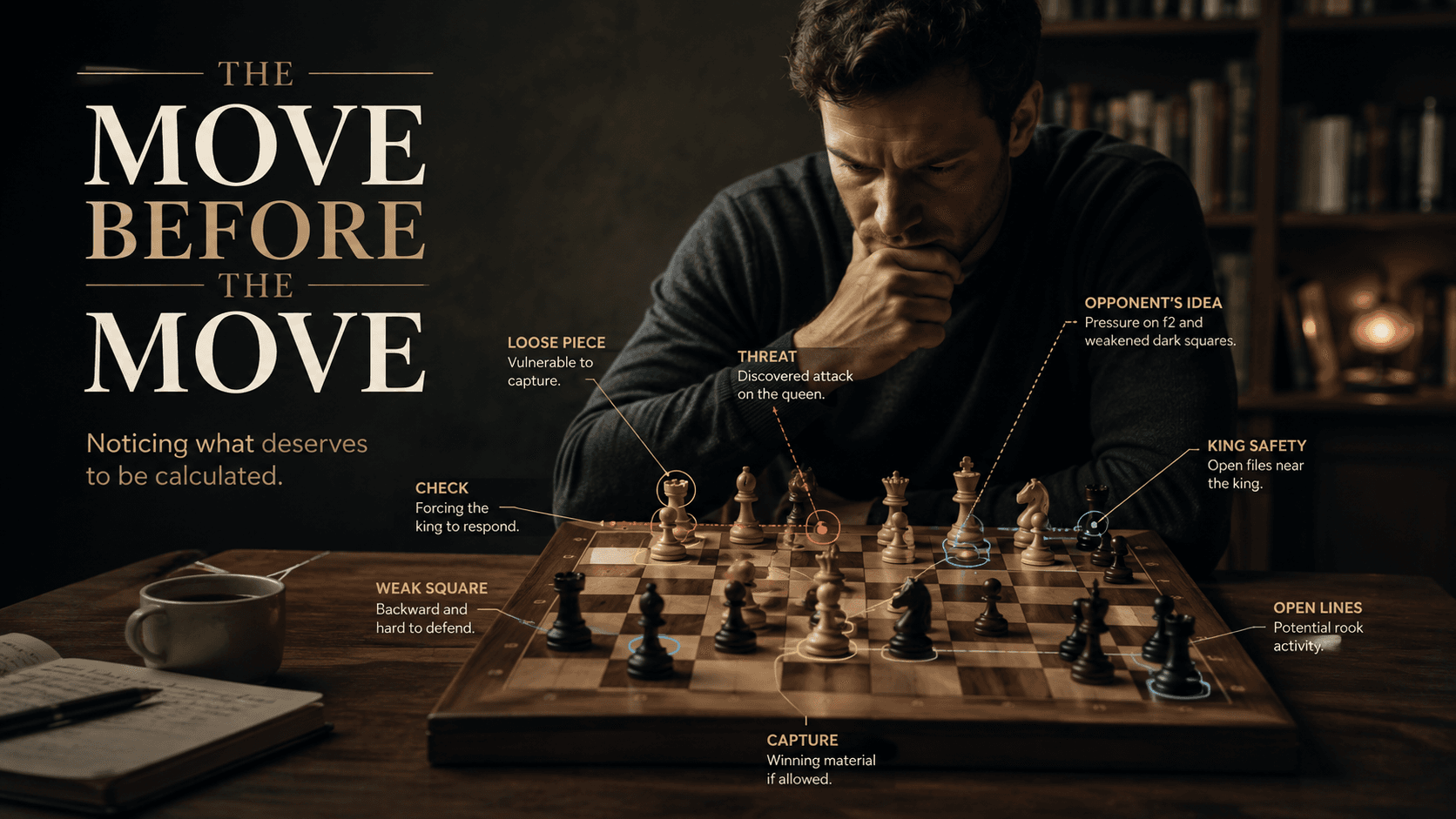
Chess improvement begins before calculation. It begins with noticing what deserves to be calculated.
There is a familiar kind of chess mistake.
You make a move. Your opponent responds. And almost immediately, you see it.
The hanging piece. The open diagonal. The backward move that wins. The threat you somehow ignored despite staring at the position for three minutes.
Nothing about the board was hidden.
You simply did not look at the right thing.
This is one of the strangest features of chess. Players often imagine improvement as an accumulation of knowledge: more openings, more tactical patterns, more endgames, more engine analysis.
Knowledge matters.
But many games are not lost because the player lacked the necessary knowledge. They are lost because the right question never entered the player's mind.
Before the move we play comes another move.
The movement of attention.
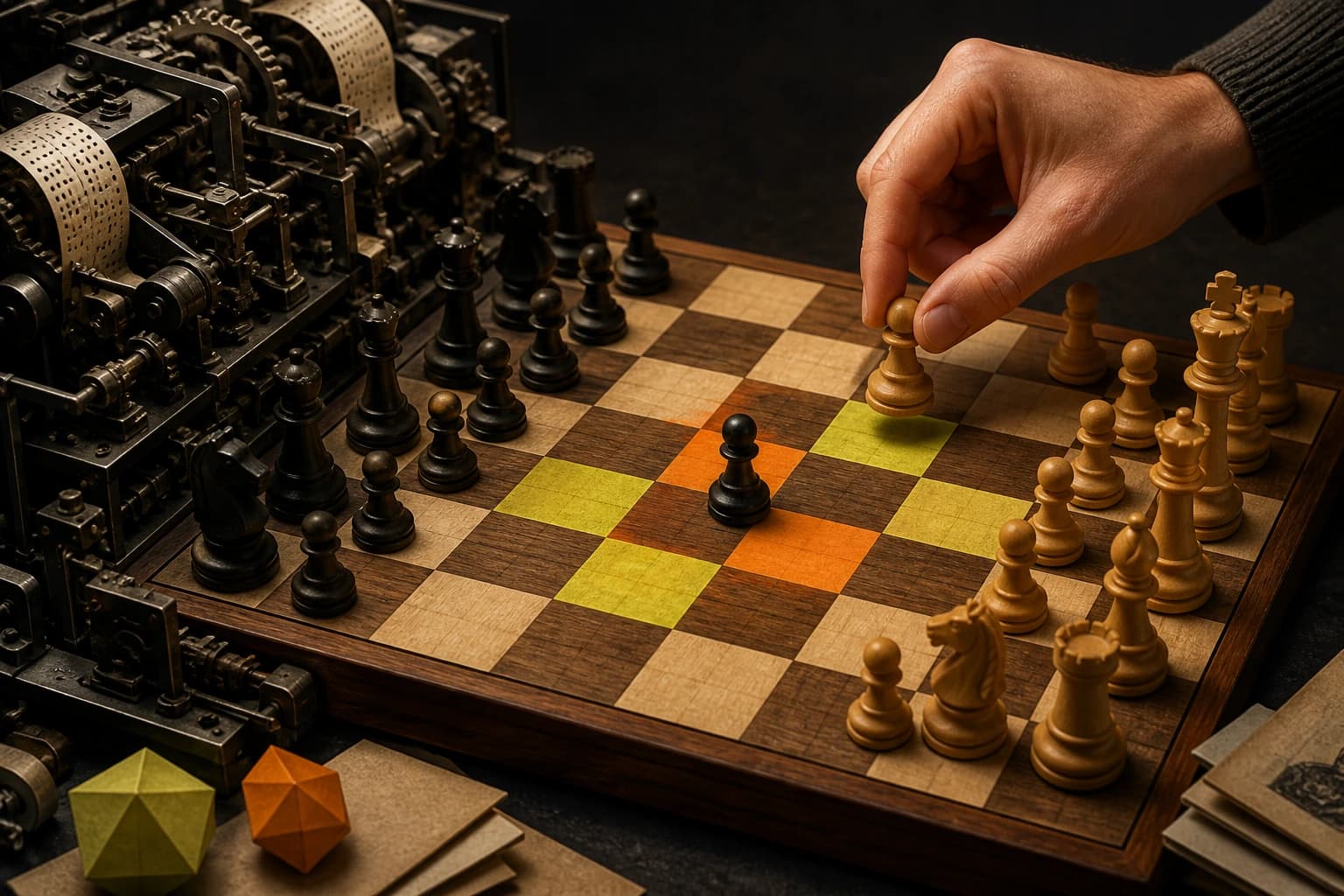
The board does not tell you what matters
Every legal chess position contains more information than a player can examine equally.
There are checks.
Captures.
Threats.
Loose pieces.
Pawn breaks.
Weak squares.
Possible exchanges.
King-safety questions.
Long-term structural problems.
Moves that matter immediately and moves that may matter twenty turns from now.
The difficulty is not merely seeing all of them.
It is deciding where to look.
A beginner often directs attention according to visual drama. A queen under attack feels important. A piece near the king feels dangerous. A pawn one square from promotion demands attention.
Stronger players become sensitive to quieter signals.
A rook with no defender.
A bishop that suddenly lost access to a diagonal.
A pawn move that weakened two squares at once.
A knight whose only retreat square disappeared.
A defender performing three jobs.
These features rarely announce themselves.
Chess therefore rewards a kind of disciplined curiosity.
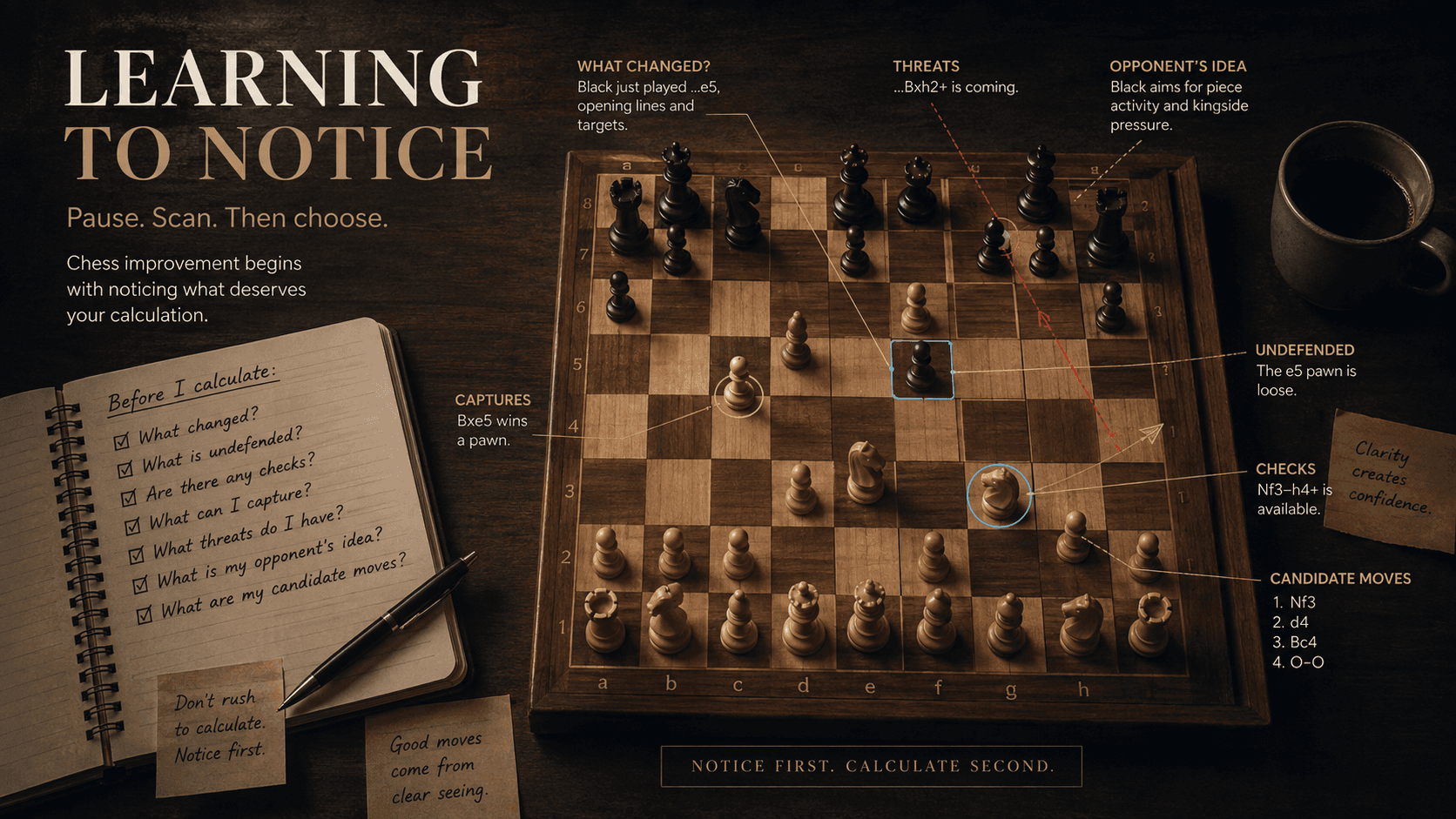
What changed?
What is undefended?
What became possible?
What became impossible?
The strongest move is often discovered by asking the strongest question.
Calculation cannot rescue bad attention
Players are often told to calculate more deeply.
Sometimes they should.
But deep calculation in the wrong direction is simply a more sophisticated way to become lost.
Imagine spending five minutes examining an attack against the enemy king while your opponent has a simple tactical threat against your queen. The calculation may be accurate. The variations may be impressive.
They are also irrelevant.
This is why chess thinking cannot be reduced to search depth.
Before exploring a line, the player must decide that the line deserves exploration.
That decision depends on judgment.
Engines can examine enormous numbers of possibilities with ruthless consistency. Humans cannot. We survive the complexity of chess by filtering.
We discard most moves almost immediately.
We recognize familiar patterns.
We concentrate on forcing ideas.
We form candidate moves.
We sense that one part of the board matters more than another.
This filtering is not a weakness in human chess.
It is the foundation of it.
The goal is not to consider everything.
The goal is to become better at deciding what not to ignore.
Every move edits the position
A useful habit in chess is deceptively simple:
After the opponent moves, do not immediately begin planning your reply.
First ask what changed.
The question sounds elementary because the answer appears obvious. A knight moved from one square to another. A pawn advanced. Two pieces were exchanged.
But every move changes more than its destination.
A bishop move may uncover a rook.
A pawn push may remove protection from a neighboring square.
A queen retreat may stop defending a distant pawn.
A capture may open a file.
A king move may change the tactical meaning of every check on the board.
The physical move is only the visible part of the event.
Its consequences spread through the position.
Strong players gradually learn to see chess this way. They do not merely register where a piece arrived. They update a network of relationships.
Lines open.
Defenders disappear.
Squares weaken.
Priorities change.
The position has been edited.
Read the new version.
Blunders are often failures of process
When players analyze their games, they frequently stop at the move that the engine marks as wrong.
This is useful, but incomplete.
Suppose you lost a rook to a knight fork.
The obvious lesson is:
Do not allow the fork.
But that lesson is so specific that it may never become useful again. You may never encounter precisely that position.
A better review asks what happened one level earlier.
Did you forget to scan the opponent's forcing moves?
Did you assume your attack was more urgent?
Did you stop checking threats after reaching a familiar position?
Did you calculate your own idea without calculating the opponent's reply?
Did you notice the knight but fail to notice that your king and rook shared a vulnerable square?
Now the mistake becomes portable.
Instead of memorizing one bad move, you identify a weakness in your decision process.
This is where analysis becomes education.
A chess engine can tell you where the evaluation changed.
A useful learning system should help you understand why your attention failed before it changed.
Candidate moves are a form of humility
One of the quiet disciplines of strong chess is resisting the first attractive idea.
The board offers temptation constantly.
A promising sacrifice.
A natural recapture.
A check that seems forcing.
A familiar opening move.
The mind likes closure. Once it discovers a plausible move, it begins searching for reasons to play it.
Chess punishes that impulse.
A simple candidate-move habit creates a small interruption:
What else?
Perhaps there is another check.
Another capture.
A quiet defensive move.
A stronger version of the same idea.
A move your opponent would hate to see.
The purpose is not to generate ten possibilities on every turn. That would be exhausting and unnecessary.
The purpose is to prevent the first reasonable thought from becoming the only thought.
This is intellectual humility in miniature.
The position may contain something you have not yet considered.
Good intuition knows when to become suspicious
Experienced players often move quickly because much of chess becomes familiar.
They recognize structures.
They feel where pieces belong.
They know which exchanges are favorable.
They sense danger before they can fully explain it.
This is one of the rewards of practice.
But intuition creates a new risk: familiarity can become automaticity.
A move looks normal, so it escapes examination.
A position resembles something known, so the differences are ignored.
The player stops seeing the board and begins seeing the category.
Good intuition therefore needs a companion.
Suspicion.
Why did my opponent make that move?
What would make the obvious response fail?
What is unusual here?
What would I notice if this were a puzzle?
These questions do not reject intuition.
They protect it from laziness.
The pause is part of the move
In fast chess, hesitation can be expensive.
In serious chess, thought must eventually end.
No player can inspect every possibility forever.
But there is a difference between thinking slowly and pausing intelligently.
Sometimes three seconds of disciplined attention prevent ten minutes of useless calculation.
Before committing, scan the board once more.
Checks.
Captures.
Threats.
Loose pieces.
The opponent's idea.
The move you are about to play.
What does it leave behind?
This little pause has almost no glamour.
It will never appear in a notation score.
Spectators cannot see it.
Engines do not evaluate it.
Yet games are constantly decided there.
Learning to notice
Chess is often presented as a game of finding answers.
In practice, it is just as much a game of discovering questions.
What matters in this position?
What changed?
What am I assuming?
What does my opponent want?
What haven't I considered?
Why does this move feel safe?
The board rarely gives us enough time to understand everything.
That is the point.
We must decide where understanding is most necessary.
With experience, this process becomes quieter. The checklist becomes instinct. The strange move becomes visible sooner. The loose piece seems to glow. A dangerous square begins to feel dangerous before calculation proves why.
The player has not learned to see everything.
Nobody does.
They have learned to miss less of what matters.
And sometimes the most important improvement in chess is not finding a better move.
It is learning where to look before making one.
Loading the conversation…